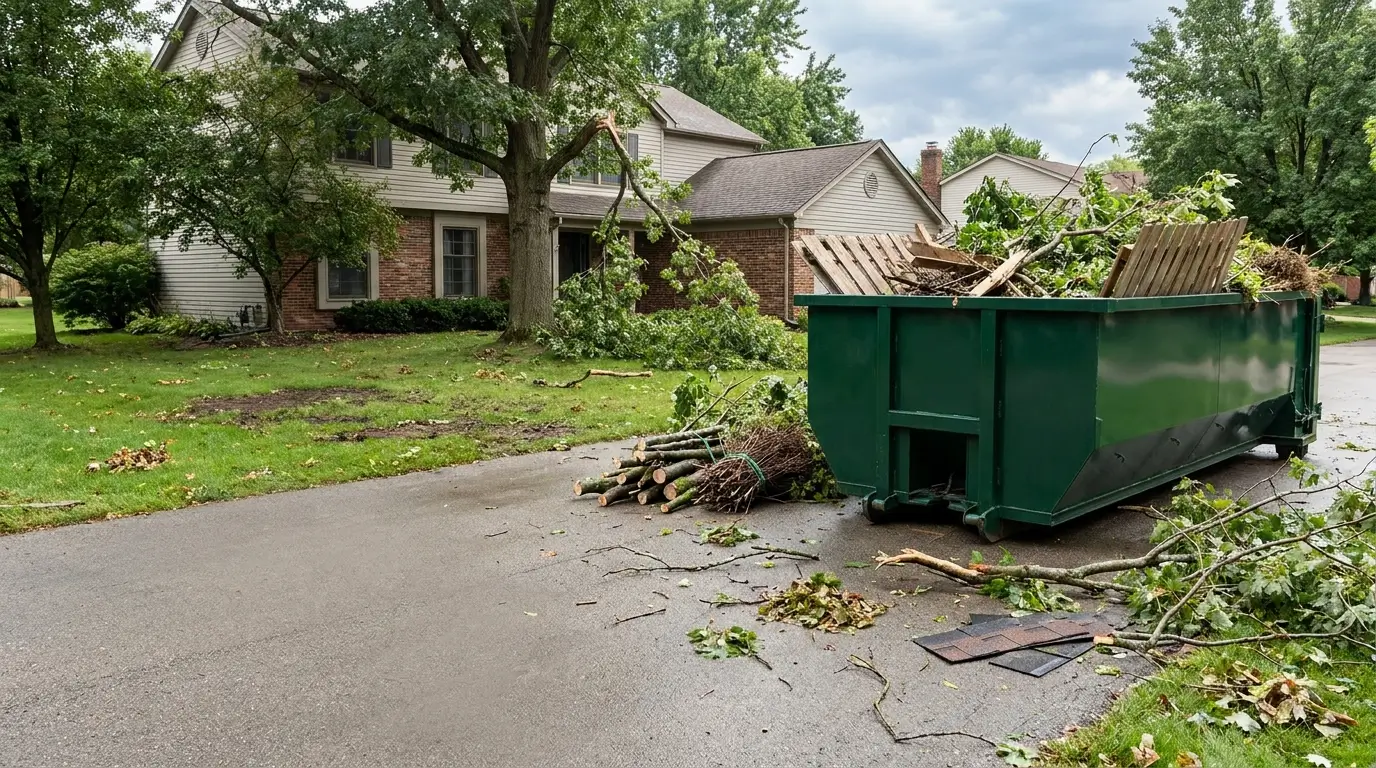
Severe weather can leave a residential property with broken tree limbs, fallen branches, damaged shrubs, scattered leaves, and other debris. High winds, heavy rain, thunderstorms, and winter storms can also damage fences, outdoor structures, and landscaping.
For homeowners in Warren, Michigan, cleaning up after a storm involves more than collecting branches and putting them at the curb. It is important to identify safety hazards, determine which trees need professional attention, understand local yard-waste collection rules, and choose an appropriate disposal method for larger quantities of debris.
A small amount of fallen brush may fit into the City’s regular compost collection program. However, a large tree removal, extensive trimming project, or storm-damaged backyard can produce more material than ordinary curbside collection is designed to handle.
A roll-off dumpster may be a practical option for managing larger volumes of approved yard and cleanup debris. The right disposal arrangement depends on the amount of waste, the type of material, and the provider’s acceptance rules.
This guide explains what Warren homeowners should know about storm cleanup, tree trimming, branch disposal, dumpster planning, and safe property maintenance.
1. Inspect Your Property Before Starting Storm Cleanup
After a storm passes, the first step should be assessing the condition of your property rather than immediately starting to move debris.
Storm damage is not always obvious. A tree may remain standing while having a split trunk, damaged roots, or a large broken limb hanging above a driveway. Branches may also conceal electrical wires or damage to outdoor structures.
Walk around your property from a safe distance and look for visible problems.
Check for fallen branches and trees
Identify branches that have fallen onto:
- Lawns and landscaping beds
- Driveways and walkways
- Patios and decks
- Fences and gates
- Sheds and detached garages
- Roofs and gutters
Small branches lying on open lawn areas may be suitable for ordinary yard cleanup. Larger limbs, damaged trunks, and trees leaning toward structures require more careful evaluation.
Look for damaged or unstable trees
A standing tree can still be hazardous after severe weather.
Watch for:
- Large branches hanging loosely in the canopy
- Cracks or splits in the main trunk
- Exposed or lifted roots
- A tree leaning differently than before the storm
- Broken limbs caught in other branches
- Significant damage near the tree’s main junctions
Do not climb the tree or attempt to pull down hanging branches yourself.
The Michigan Department of Natural Resources recommends having professionals handle dangerous storm-damaged trees and branches, especially when they are near power lines or resting on buildings. <Cite refs={[“turn177685search7″,”turn177685search9”]}/>
Check your home and outdoor structures
Storm cleanup may also involve inspecting:
- Roof shingles and gutters
- Siding and exterior trim
- Deck railings and stairs
- Fence panels and posts
- Garage doors
- Outdoor lighting
- Garden sheds and storage structures
If a tree has struck your home, avoid disturbing the damaged area until the structural condition has been assessed.
2. Put Electrical Safety Ahead of Yard Cleanup
One of the most serious storm cleanup hazards is a fallen electrical line.
A power line may be hidden beneath leaves, branches, standing water, or other debris. A wire that appears inactive may still be energized.
Never begin cutting or moving storm-damaged branches until you are confident that the area is free of electrical hazards.
What to do if you find a downed power line
Follow these precautions:
- Stay at least 25 feet away from a downed power line.
- Do not touch the wire or anything that may be contacting it.
- Keep children and pets away from the area.
- Do not attempt to move a branch, fence, or tree touching the wire.
- Contact emergency services if there is an immediate danger.
- Report electrical outages or downed utility lines to the utility company.
DTE Energy advises residents to treat downed wires as energized and stay at least 25 feet away from them and anything they contact. Its outage and emergency information is available through its official website. <Cite refs={[“turn177685search10″,”turn177685search4”]}/>
For an electrical outage or downed-wire report, DTE Energy lists its reporting number as 800-477-4747.
Do not operate chainsaws near electrical hazards
Chainsaws are frequently used during tree cleanup, but they should never be used near downed electrical wires or unstable trees.
A branch can shift unexpectedly when cut. A damaged tree can also release stored tension, causing limbs or sections of the trunk to move suddenly.
If a tree is leaning against a house, resting on a power line, or has large suspended branches, arrange professional assistance.
3. When Should You Hire a Professional Tree Service?
Not every storm cleanup job requires professional tree removal. Homeowners can often handle small branches and ordinary yard debris when the area is safe.
However, larger tree work can involve significant risks.
Situations that require professional attention
Consider contacting a qualified tree service when:
- A large limb is hanging above a roof or driveway.
- A tree has split or cracked near the trunk.
- A tree is leaning toward a building.
- Roots have been lifted or exposed.
- A tree has fallen onto a house or garage.
- Large branches are tangled in other trees.
- The work requires climbing or operating equipment above ground.
- A tree is close to electrical service lines.
Professional tree workers can assess whether a tree needs pruning, removal, or additional monitoring.
Why DIY tree removal can be dangerous
A large tree may appear stable while having internal damage or weakened roots. Cutting the wrong branch can change the balance of the tree and cause it to fall unexpectedly.
Chainsaws also create risks involving kickback, falling limbs, sharp equipment, and unstable cutting surfaces.
Homeowners should avoid attempting major tree removal without the appropriate experience, equipment, and safety procedures.
What to ask before hiring a tree service
Before agreeing to the work, ask:
- Is the company insured for property damage and liability?
- Does the quote include cutting and hauling?
- Are stump grinding or stump removal included?
- Will the crew remove branches from the roof or other structures?
- Is cleanup of sawdust and small debris included?
- Where will the wood and branches be taken?
- Are additional charges possible for difficult access?
Get the scope of work in writing so you understand what the contractor will remove and what will remain on the property.
4. Understand Warren’s Tree Trimming and Property Maintenance Rules
Tree maintenance is not only about appearance. Branches that obstruct sidewalks, streets, or visibility can create problems for pedestrians and drivers.
Warren’s vegetation ordinance includes requirements for vegetation that overhangs public ways.
Under the City’s published tree ordinance, property owners or the people responsible for a property must trim vegetation overhanging public ways to the property line or maintain a clear height of at least eight feet above the public way. The ordinance also addresses branches that obstruct street lighting or interfere with visibility. <Cite refs={[“turn177685search32”]}/>
Keep sidewalks and public ways clear
Branches and shrubs should not obstruct:
- Sidewalks
- Pedestrian pathways
- Street visibility
- Street lighting
- Other public access areas
If vegetation creates a hazard near a street or sidewalk, address it promptly and check the City’s applicable requirements.
What if the damaged tree is on public property?
Not every tree near a home belongs to the homeowner.
A tree in a public easement or another City-maintained area may fall under municipal responsibility.
Warren’s Forestry Division has historically handled maintenance of public-easement trees. The City’s published guidance directs residents to contact the Forestry Division at (586) 268-8404 when a public-easement tree creates an immediate hazard and needs evaluation. Because contact details and procedures can change, confirm the current process with the City. <Cite refs={[“turn177685search5”]}/>
Before hiring someone to remove a tree close to a sidewalk or public easement, clarify who is responsible for it.
5. Know Which Storm Debris Warren Accepts Through Curbside Collection
Warren provides a curbside compost collection program for eligible yard waste.
However, the program has material, size, and seasonal restrictions. Homeowners should not assume that every branch or tree section can be placed at the curb.
According to the City’s Sanitation Division, regular compost season generally runs from April 1 through December 1. Curbside compost collection is not provided from December 2 through March 31, although compost is accepted at the Recycling Center year-round under its applicable rules. <Cite refs={[“turn177685search0″,”turn177685search31”]}/>
Small branches and shrubs
Warren’s published curbside guidelines require tree branches and shrubs to be:
- Tied securely into manageable bundles
- Four feet or less in length
- Under two inches in diameter
- Light enough for one person to lift
These limits are important for homeowners cleaning up after a storm.
A pile of long, heavy branches does not automatically qualify for curbside compost collection just because it is natural yard waste.
Leaves and smaller yard waste
Eligible materials include:
- Grass clippings
- Leaves
- Garden debris
- Flower-bed waste
- Small brush
The City requires eligible yard waste to be placed in its designated 95-gallon compost cart with a brown lid or in 30-gallon biodegradable brown paper bags.
Plastic bags are not accepted for curbside compost collection.
Keep compost separate from regular garbage
Warren’s guidelines require compost material to be placed five feet away from other garbage at the curb.
Residents should also follow the City’s collection timing rules. The material should be ready by 6 a.m. on collection day or placed at the curb no earlier than 6 p.m. on the previous evening.
Check the City’s current collection schedule before putting storm debris out for pickup. <Cite refs={[“turn177685search31”]}/>
6. What Happens to Large Tree Branches, Trunks, and Stumps?
Large storm-damaged trees can produce much more material than a regular curbside compost program can accommodate.
A single mature tree may create:
- Large trunk sections
- Thick limbs
- Smaller branches
- Bark and wood chips
- Root sections
- A stump
- Leaves and smaller brush
These materials need to be handled according to their size and the available disposal options.
Large branches
Branches that exceed the City’s curbside size limits should not be placed out as ordinary compost.
Depending on their condition and quantity, possible options include:
- Professional tree-service hauling
- Approved yard-waste drop-off
- A suitable private waste-removal provider
- A roll-off dumpster that accepts the material
Tree trunks and logs
Warren’s published curbside rules state that logs, tree trunks, and tree stumps are not collected through regular curbside service. <Cite refs={[“turn177685search0″,”turn177685search31”]}/>
Do not place large trunk sections at the curb expecting normal compost pickup.
For disposal options, contact the City’s Sanitation Division at (586) 775-1400 and confirm its current requirements before transporting material.
Tree stumps
Stumps can be particularly difficult to dispose of because they are heavy, bulky, and often contain soil and roots.
The City’s current Sanitation Division information lists tree stumps among the materials it does not accept at the Recycling Center. Do not assume that an old disposal instruction or another municipality’s policy applies to Warren. Call the City for current guidance. <Cite refs={[“turn177685search0”]}/>
A private provider may also have restrictions on stumps, root balls, and soil-covered wood.
Roots and soil
Roots can contain significant amounts of soil, and soil is much heavier than ordinary branches.
Warren’s curbside guidance instructs residents to separate roots from shrubs, remove the dirt, and handle the root material with regular garbage while placing the cut and bundled shrub with compost.
Large root balls and excavated soil should be discussed separately with a disposal provider.
7. When a Dumpster Makes Sense for Storm Cleanup
Curbside collection is useful for routine yard maintenance and small quantities of eligible brush. However, it may not be practical after a major storm or a large tree-trimming project.
A roll-off dumpster can provide a centralized place for approved debris while cleanup is underway.
It may be useful when:
- Several trees have dropped branches.
- A large amount of brush needs to be removed.
- A professional tree service is clearing multiple trees.
- A property has accumulated branches over several months.
- Storm damage has affected landscaping and outdoor structures.
- The homeowner is combining yard cleanup with a renovation project.
A dumpster is particularly helpful when debris volume is too large for ordinary household collection.
What can potentially go in a yard-cleanup dumpster?
Depending on the provider’s acceptance rules, approved materials may include:
- Small and medium-sized branches
- Brush
- Leaves
- Shrubs
- Cut tree limbs
- Certain landscaping debris
- Other approved outdoor cleanup waste
However, not every roll-off provider accepts green waste or mixed yard debris.
Some containers are intended for construction and demolition waste rather than yard waste. Others may accept clean brush but restrict soil, stumps, or large logs.
Always describe the material before arranging delivery.
Why material separation matters
Mixing tree debris with other waste can affect disposal options.
For example, a dumpster containing clean brush may be eligible for a different processing route from a container containing branches, plastic, roofing debris, and household junk.
If possible, separate:
- Clean branches and brush
- Leaves and grass
- Logs and large trunk sections
- Soil and root balls
- Construction or household debris
This makes it easier to identify the correct disposal arrangement and avoid rejected materials.
8. Choose the Right Dumpster Size for Storm Debris
The correct dumpster size depends on the volume and type of material being removed.
Common roll-off container sizes include 10, 15, 20, 30, and 40 cubic yards. Availability, dimensions, and weight allowances vary by provider.
| Dumpster size | Possible cleanup application |
|---|---|
| 10-yard | Small yard cleanup and limited brush |
| 15-yard | Moderate branch and shrub removal |
| 20-yard | Larger yard cleanup or several trimming projects |
| 30-yard | Extensive brush removal and mixed approved debris |
| 40-yard | Large-volume cleanup involving bulky, relatively lightweight material |
These are general planning examples, not guaranteed capacities for every storm cleanup job.
10-yard dumpster for smaller cleanup projects
A 10-yard dumpster may work for a limited cleanup involving:
- Branches from a few small trees
- A modest amount of brush
- Shrub removal
- General outdoor debris
It may be suitable when the project does not involve large logs or heavy root sections.
15-yard dumpster for moderate cleanup
A 15-yard container may provide more room when several shrubs, branches, and landscaping materials need to be removed.
It can be considered for a homeowner cleaning up a larger backyard or handling several trimming tasks together.
20-yard dumpster for larger storm cleanup
A 20-yard dumpster may be useful when a property has substantial branch debris or multiple areas need attention.
For example, a homeowner may need to remove fallen limbs, damaged shrubs, old landscaping material, and approved outdoor debris after a severe storm.
30- and 40-yard dumpsters for extensive cleanup
Larger containers may be appropriate when a major property cleanup produces substantial volumes of relatively lightweight material.
However, they are not automatically suitable for heavy logs, soil, stumps, or root balls.
A large container may have plenty of physical space but still exceed its permitted weight.
For additional sizing guidance, read 10 vs 15 vs 20 Yard Dumpster: Which One Do You Need? and 20 Yard vs 30 Yard Dumpster for Remodels and Cleanouts.
9. Understand Weight Limits for Tree and Yard Debris
Many homeowners think about dumpster capacity in terms of how full the container looks. However, weight restrictions can be just as important as volume.
Tree debris can vary considerably in weight depending on the type of wood, moisture content, size, and condition.
Wet wood is heavier than dry wood
Branches and logs that have absorbed rainwater can weigh significantly more than dry material.
A dumpster filled with wet storm debris may approach its weight allowance sooner than expected.
This is particularly important after a period of heavy rainfall.
Logs and trunk sections can add substantial weight
Large pieces of wood are dense and difficult to handle.
A container intended for ordinary yard debris may not be suitable for multiple large trunk sections.
Ask the provider whether logs are accepted and whether there are restrictions on their length, diameter, or quantity.
Soil and root balls require special attention
A root ball can contain wood, roots, rocks, and a considerable amount of soil.
Because soil is dense, even a small number of large root balls can add substantial weight.
Do not load root balls or large quantities of dirt without approval.
Ask about the included weight allowance
Before renting, ask:
- What is the container’s weight allowance?
- Are wet branches and logs accepted?
- Are large trunk sections allowed?
- Can soil or root balls be included?
- Are there separate restrictions for clean brush?
- What happens if the container exceeds its weight allowance?
For more information about weight limits and possible additional charges, read Dumpster Overage Fees: How Weight Limits Affect Your Final Bill.
10. Prepare Storm Debris for Efficient Dumpster Loading
Once the cleanup area is safe and the disposal arrangement is confirmed, organizing the material can make loading more efficient.
Separate branches by size
Create separate piles for:
- Small branches
- Medium-sized limbs
- Large limbs
- Logs
- Leaves and loose brush
This helps identify which materials can be handled through ordinary yard-waste collection and which require another disposal method.
Cut branches into manageable lengths
Where it is safe and appropriate, branches can be cut into smaller sections that fit inside the approved disposal container.
Do not cut branches that are under tension, hanging above ground, resting on structures, or entangled with electrical wires.
Those situations should be handled by qualified professionals.
Arrange branches to reduce wasted space
Branches are irregularly shaped and can leave empty spaces inside a dumpster.
When loading is permitted, arranging similar-sized pieces together may help use the available space more effectively.
Avoid forcing branches into the container or allowing long limbs to extend above its walls.
Keep the load below the fill line
The debris must remain within the container’s loading limits.
Do not allow branches or other materials to extend above the container walls. Overfilled dumpsters may not be safe to transport and may be refused for pickup.
Do not mix prohibited materials
A yard-debris dumpster should not automatically be treated as a general-purpose waste container.
Ask before adding:
- Paint and chemicals
- Batteries
- Tires
- Appliances
- Electronics
- Roofing shingles
- Household garbage
- Soil and stones
- Treated or contaminated materials
The provider’s accepted-material list should guide the loading process.
11. Protect Your Property During Dumpster Delivery
Storm cleanup can already involve damaged lawns, soft soil, broken pavement, and limited driveway access.
A roll-off dumpster should be placed carefully to avoid creating additional problems.
Choose a suitable location
Before delivery, identify a level area with enough space for the container and delivery vehicle.
Check for:
- Overhead branches
- Utility lines
- Narrow access points
- Soft or uneven ground
- Damaged concrete
- Driveway slope
- Garage and gate access
A location that looks suitable from the street may not provide enough room for the delivery truck to maneuver.
Discuss driveway protection
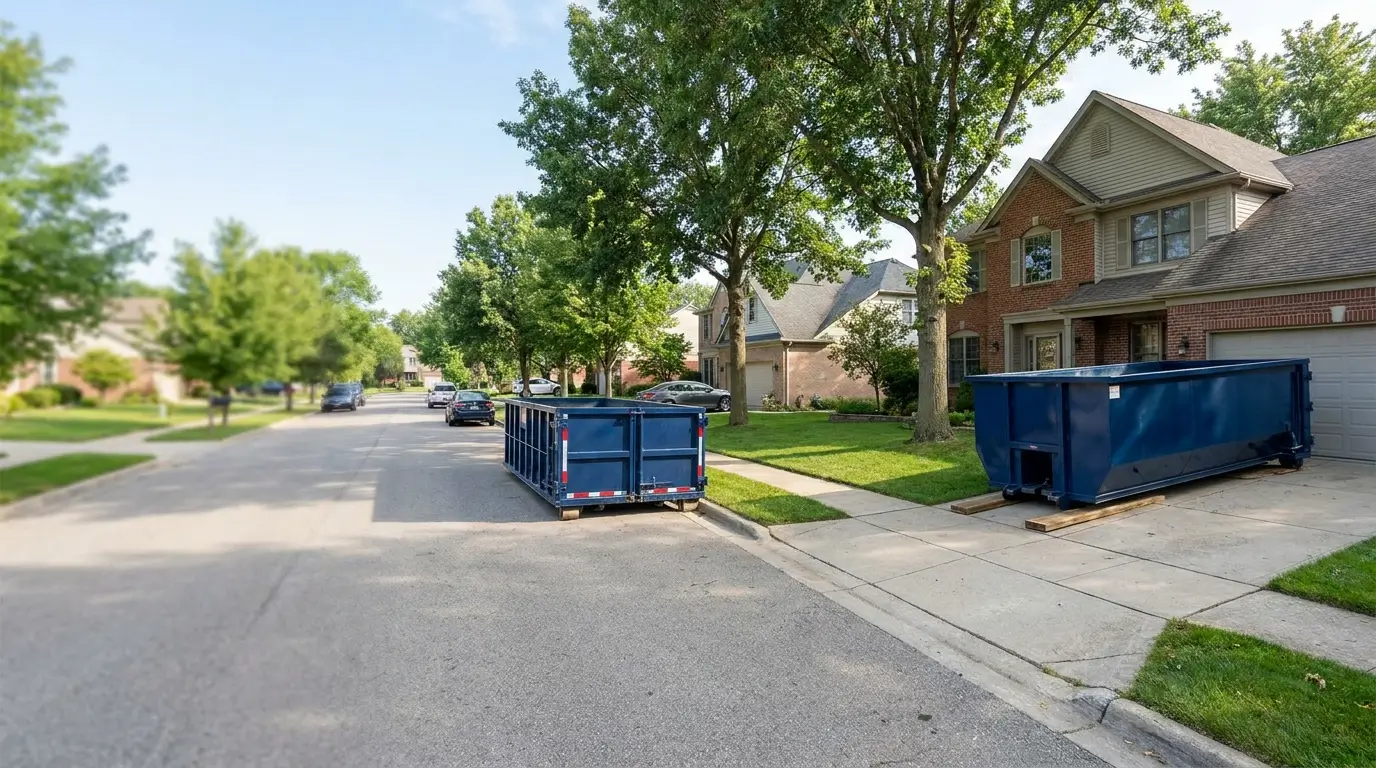
If the dumpster will be placed on a concrete or asphalt driveway, ask the provider whether protective boards or another surface-protection method should be used.
This can help reduce direct contact with the driveway, although it cannot guarantee that damage will not occur.
Avoid obstructing sidewalks and roads
Do not place a container where it blocks pedestrian access, creates visibility problems, or interferes with traffic.
If you are considering a street or public right-of-way location, confirm applicable requirements with the City and the provider before delivery.
Keep the work area accessible
Place the dumpster as close as practical to the cleanup area while maintaining safe access for workers and equipment.
The location should allow debris to be carried without creating unnecessary hazards.
12. What Does Storm Cleanup and Dumpster Rental Cost?
Storm cleanup costs vary depending on the size of the job, the amount of tree work required, and the disposal arrangements.
There is no single price that applies to every property.
Tree trimming and removal
A small trimming project may involve only cutting and removing a few branches.
A large tree removal may require specialized equipment, a larger crew, and additional work to protect nearby structures.
The quote may depend on:
- Tree height and diameter
- Accessibility
- Proximity to buildings and utility lines
- Amount of damaged material
- Whether stump grinding is included
- Whether hauling and final cleanup are included
Ask the tree service to explain exactly what is included.
Dumpster size and rental period
The container size and length of rental can influence the total cost.
A larger container may cost more than a smaller one, while keeping a dumpster longer than the included period may result in additional charges.
Confirm the rental duration before scheduling delivery.
Disposal weight and material type
Wet branches, logs, root balls, and soil may create different disposal costs from ordinary dry brush.
Some providers have separate rules for clean green waste and mixed debris.
Ask whether the quote includes a weight allowance and whether particular materials have additional charges.
Additional services
Your project may also involve:
- Stump grinding
- Tree hauling
- Branch chipping
- Special equipment
- Additional labor
- Multiple disposal containers
These services may be provided by different contractors and should be confirmed separately.
For more cost-planning advice, see What Affects Dumpster Rental Cost in Warren, MI? and 7 Ways to Lower Your Dumpster Rental Bill.
13. Should You Use Curbside Collection or Rent a Dumpster?
The right disposal method depends on the size of the cleanup.
Warren’s curbside compost program can be useful for ordinary yard maintenance and small amounts of eligible brush. A private disposal arrangement may be more practical when the project produces large volumes of debris or oversized material.
| Cleanup situation | Possible disposal option |
|---|---|
| A few small branches | City curbside compost, if size requirements are met |
| Leaves and small garden debris | City compost cart or approved paper bags |
| Bundled branches under City limits | City curbside compost |
| Large tree limbs | Professional hauling or an approved private provider |
| Large tree trunks | Confirm a suitable disposal facility |
| Tree stumps | Contact the City or a private disposal provider |
| Extensive storm brush | Dumpster or professional tree-service hauling |
| Soil and root balls | Separate disposal arrangement after provider approval |
Consider the City’s Recycling Center
Warren operates a Recycling Center at:
25801 Flanders Avenue, Warren, MI
The City’s Sanitation Division lists the following contact information:
- Phone: (586) 775-1400
- Monday–Friday: 7:30 a.m.–4 p.m.
- Saturday: 8 a.m.–noon, subject to change
The facility is intended for eligible Warren residents, and its acceptance rules are different from those of a licensed commercial disposal facility.
The City’s current information specifically lists tree stumps among the materials it does not accept. Call before transporting unusual or large quantities of storm debris. <Cite refs={[“turn177685search0”]}/>
Contractors should not assume they can use the City’s resident drop-off facility for project waste.
14. Coordinate Tree Services and Dumpster Delivery
When a storm cleanup project involves a professional tree service and a dumpster, coordinating the schedule can reduce delays.
There are several ways to organize the work.
Option 1: Tree service handles all hauling
Some tree services include hauling and disposal in their quote.
This can be convenient when the project involves large trees, heavy limbs, or stump work.
Before hiring the company, confirm whether all debris will be removed or whether some material will remain on the property.
Option 2: Arrange a separate dumpster
A separate dumpster may be useful when the homeowner or contractor plans to manage debris loading independently.
This arrangement can work for approved brush, branches, and other accepted materials.
The tree service and dumpster provider should agree on the material types and loading arrangements before work begins.
Option 3: Combine storm cleanup with other property work
Some homeowners use storm cleanup as an opportunity to remove damaged fencing, old outdoor structures, or unwanted landscaping materials.
If you plan to combine several projects, estimate the total debris volume and weight.
Do not assume a container suitable for clean brush will accept mixed construction materials, or vice versa.
15. Common Storm Cleanup Mistakes to Avoid
Storm cleanup can become more expensive or difficult when disposal and safety are not considered in advance.
Starting cleanup before checking for electrical hazards
This is one of the most serious mistakes.
Downed wires may be hidden under branches and debris. Always treat unknown wires as energized and keep a safe distance.
Attempting dangerous tree work without professional help
Large suspended branches, split trunks, and unstable trees can move unexpectedly.
Do not climb or cut trees that require specialized equipment or expertise.
Putting oversized branches at the curb
Warren has specific requirements for bundled branches. Oversized limbs and trunks are not accepted through ordinary curbside compost collection.
Assuming the Recycling Center accepts stumps
The City’s current information lists tree stumps as unacceptable at the Recycling Center. Confirm disposal options before loading a vehicle.
Renting a dumpster without confirming green-waste acceptance
Some providers accept general construction debris but restrict clean brush or logs.
Always describe the material before ordering.
Underestimating wet debris weight
Rain-soaked branches and logs can be heavier than expected.
Check the weight allowance and ask about restrictions on large wood.
Leaving debris near storm drains
Avoid piling leaves, branches, or loose debris where they can enter storm drains or waterways.
Proper debris management helps reduce drainage problems and protects local waterways. Michigan EGLE recommends checking with local waste providers and municipalities for appropriate storm-debris management and recycling options. <Cite refs={[“turn177685search8”]}/>
16. Storm Cleanup Checklist for Warren Homeowners
Use this checklist to organize the work after a storm.
Safety and property inspection
- Check the property from a safe location.
- Look for fallen and damaged trees.
- Check for downed or hanging electrical wires.
- Keep children and pets away from hazardous areas.
- Inspect roofs, fences, decks, and sheds.
- Contact professionals for dangerous tree conditions.
Tree and yard cleanup
- Separate small branches from large limbs.
- Identify logs, trunks, and stumps.
- Separate soil and root balls.
- Check whether the damaged tree is on private or public property.
- Confirm applicable Warren tree-maintenance requirements.
Disposal planning
- Review the City’s curbside compost guidelines.
- Check seasonal collection availability.
- Bundle eligible small branches correctly.
- Contact the City about oversized material.
- Confirm private-provider acceptance rules.
- Estimate the total debris volume and weight.
Dumpster preparation
- Choose an appropriate container size.
- Confirm green-waste acceptance.
- Ask about logs, wet wood, soil, and stumps.
- Check the weight allowance.
- Choose a safe placement location.
- Confirm delivery, rental duration, and pickup arrangements.
17. How Warren Dumpster Rental Can Help With Storm Cleanup Planning
Storm cleanup can involve multiple types of debris, different disposal requirements, and tight project schedules.
Warren Dumpster Rental helps connect homeowners and other customers with independent dumpster rental providers serving Warren, Michigan, and nearby communities where coverage is available.
The matched provider handles availability, rental arrangements, pricing, billing, delivery, and pickup.
When requesting a dumpster for storm cleanup, explain what you need to remove.
For example, tell the provider whether your project involves:
- Small branches and brush
- Large tree limbs
- Shrubs and landscaping debris
- Logs and trunk sections
- Leaves and garden waste
- Mixed outdoor renovation debris
Also mention whether the material is wet, whether soil or root balls are included, and approximately how much debris you expect.
This information helps the provider determine whether it accepts the material and which container or alternative arrangement may be appropriate.
For larger tree removal projects, coordinate the disposal plan with the tree service before work begins.
Whether you are clearing a few fallen branches or organizing a substantial backyard cleanup, arranging disposal in advance can help keep the project organized.
Frequently Asked Questions
What should I do first after a storm damages trees in Warren?
Inspect the property from a safe distance and look for downed electrical lines, hanging branches, unstable trees, and damage to buildings. Do not begin moving debris until electrical hazards have been ruled out. Contact qualified professionals for dangerous tree conditions.
Does Warren collect fallen tree branches at the curb?
Warren collects eligible small branches and shrubs through its seasonal compost program. Branches must be securely bundled, no longer than four feet, under two inches in diameter, and light enough for one person to lift. Larger limbs and trunks are not accepted through ordinary curbside collection.
When does Warren’s curbside compost season operate?
The City’s published schedule generally runs from April 1 through December 1. There is no regular curbside compost pickup from December 2 through March 31, although eligible compost material is accepted at the Recycling Center year-round under its rules. Check the current schedule before relying on these dates.
Can I put large tree branches in my regular trash cart?
Large branches should not be placed in the regular trash cart unless they meet the applicable collection requirements. Warren has separate rules for compostable branches and shrubs. Oversized limbs require another disposal arrangement.
Does Warren pick up tree trunks and stumps?
The City’s published curbside rules state that logs, tree trunks, and stumps are not collected curbside. Its current Recycling Center information also lists stumps as unacceptable. Contact the Sanitation Division for current disposal guidance.
Can I rent a dumpster for storm-damaged branches?
Yes, if the selected provider accepts the type of yard debris you need to remove. Some providers accept clean brush and branches, while others have restrictions on green waste, logs, or mixed materials. Confirm acceptance before delivery.
What size dumpster do I need for storm cleanup?
A smaller container may be sufficient for limited branch cleanup, while a 15- or 20-yard container may be worth considering for a larger yard project. Extensive cleanup may require a larger container. The correct choice depends on material volume, weight, and provider restrictions.
Can I put wet branches in a dumpster?
Some providers accept wet branches, but moisture increases the weight of wood. Ask about the weight allowance and any restrictions on wet or heavy material before loading.
Can tree stumps go in a roll-off dumpster?
Not every provider accepts tree stumps. Stumps and root balls can be unusually heavy and may contain soil and rocks. Confirm acceptance and weight requirements before arranging a container.
Do I need a professional to remove a storm-damaged tree?
Professional assistance is recommended when a tree is unstable, split, leaning, resting on a building, or tangled with power lines. Small branches on the ground may be manageable when the area is safe, but hazardous tree work should be left to qualified professionals.
Who should I contact about a dangerous public-easement tree in Warren?
Warren’s published Forestry Division guidance lists (586) 268-8404 for evaluating hazardous public-easement trees. Confirm the current contact procedure with the City before arranging private removal work.
Can I mix yard waste with household junk in one dumpster?
It depends on the provider’s material-acceptance policy. Clean brush, household garbage, construction debris, soil, and treated materials may have different disposal requirements. Ask before mixing materials.
Should I rent a dumpster or hire a tree service to haul everything away?
A tree service may be more appropriate for hazardous tree removal and large limbs, particularly when specialized equipment is required. A separate dumpster may be useful for approved debris that you or your contractor can load. Compare the complete service scope before deciding.
Final Thoughts
Storm cleanup and tree trimming are important parts of maintaining a safe and attractive property. After severe weather, homeowners should first identify electrical and structural hazards, arrange professional help for dangerous tree work, and separate ordinary yard waste from oversized debris.
Warren’s curbside compost program can handle eligible small branches and routine yard waste during its collection season, but large limbs, logs, trunks, and stumps require different arrangements.
For larger cleanup projects, a properly selected roll-off dumpster may provide a convenient way to manage approved debris. Confirm material acceptance, weight limits, container size, and placement requirements before scheduling delivery.
With a clear cleanup and disposal plan, Warren homeowners can handle storm-related property maintenance more safely and efficiently.