Renting a roll-off dumpster is a convenient way to manage waste during a home renovation, garage cleanout, roofing project, landscaping job, or property cleanup. However, before scheduling delivery, homeowners in Warren, Michigan, need to decide where the container can legally and safely be placed.
For many residential projects, the driveway seems like the easiest option. It keeps the dumpster close to the house, provides convenient access for loading, and avoids taking up space on the street. But driveway placement still requires attention to property boundaries, the City’s placement restrictions, and the delivery company’s access requirements.
Street placement can be more complicated. A dumpster positioned on a public road, sidewalk, or right-of-way may interfere with traffic, pedestrians, neighboring driveways, and municipal services. Warren also has specific code provisions restricting where privately serviced roll-off dumpsters can be located.
Understanding these rules before delivery can help prevent scheduling problems, unexpected relocation requests, and potential code violations.
This guide explains where you can put a dumpster in Warren, how driveway and street placement differ, what homeowners should check before delivery, and how to prepare a suitable location.
1. Why Dumpster Placement Matters
A roll-off dumpster is not an ordinary garbage can. It is a large container delivered by a specialized truck and left at a designated location for temporary use.
The container needs enough room for delivery, safe loading, and eventual pickup. Its placement can also affect access to the property and surrounding public areas.
Choosing the wrong location can create several problems:
- Blocking a sidewalk or pedestrian route
- Restricting access to a neighboring driveway
- Interfering with traffic or street parking
- Obstructing visibility near an intersection
- Damaging pavement or landscaping
- Blocking garage doors or other entrances
- Violating local placement restrictions
- Preventing the delivery truck from positioning the container safely
Before ordering a dumpster, consider both the physical space available and the rules that apply to the proposed location.
For homeowners in Warren, the most important distinction is between private property and public property. However, the City’s placement rules also address the position of non-city-served dumpsters in relation to the building line.
2. Can You Put a Dumpster in Your Driveway in Warren?
A driveway is often the first location homeowners consider when renting a dumpster.
It is close to the house, generally convenient for loading, and may keep the container away from moving traffic. However, homeowners should not assume that any location on a driveway is automatically permitted.
Understand Warren City Code Section 97.13
Warren City Code Section 97.13 addresses roll-off and front-load dumpsters.
The provision for non-city-served dumpsters states that these containers must be accessible to private contractors and maintained in good condition. It also restricts their placement:
- In front of a business or residence
- In front of the building line closest to the street
- On a public right-of-way
This language is important when planning residential dumpster placement.
A driveway may be privately owned or part of a private residential lot, but the City’s restriction concerning the building line still needs to be considered.
Do not assume that placing a dumpster somewhere on a private driveway automatically makes the location acceptable. The exact position relative to the building line and the property layout matters.
Before scheduling delivery, confirm the proposed placement with the City and the dumpster provider. If your driveway is entirely in front of the house’s building line, ask specifically whether the proposed location is allowed under Section 97.13.
The City provides access to its municipal code through its official website. You can also contact the appropriate City department for clarification about a particular property.
Why driveway placement can still be convenient
When a suitable location is available and the placement complies with applicable requirements, a driveway can offer several advantages.
Convenient loading: Workers can move debris directly from the house or garage to the container.
Reduced street obstruction: The dumpster stays away from normal traffic and public parking areas.
Better project organization: A designated loading area can help keep construction debris from spreading across the property.
Easier access control: Homeowners can monitor the container and the surrounding work area.
The important point is to choose an acceptable location rather than simply the most convenient one.
3. Can You Put a Dumpster on the Street in Warren?
Street placement may seem like an easy solution when a driveway is too small or unavailable. However, using a public street for a privately rented dumpster creates additional legal and practical concerns.
A residential street is public space. Placing a large container there can affect vehicles, pedestrians, neighboring properties, and municipal access.
Warren City Code Section 97.13 specifically restricts non-city-served dumpsters from being placed on a public right-of-way.
For this reason, homeowners should not assume that a standard street-placement permit is available or that paying a dumpster company automatically authorizes placement on public property.
Why street placement is restricted
Public streets and rights-of-way serve several purposes beyond vehicle parking.
They provide access for:
- Residential and commercial traffic
- Emergency vehicles
- Waste collection trucks
- Utility and maintenance crews
- Pedestrians and other road users
A roll-off dumpster can occupy a substantial amount of space and create visibility or access problems.
Even a container positioned near the curb may interfere with traffic or other public uses.
Does a permit automatically allow street placement?
No. A permit or approval for one type of right-of-way activity does not automatically authorize every other use of public property.
For example, a homeowner may need a right-of-way permit for certain construction or repair activities. That does not mean the same approval automatically allows a private roll-off dumpster to occupy a street.
Before considering street placement:
- Explain the proposed location to the City.
- Identify that the request concerns a privately rented roll-off dumpster.
- Ask whether the placement is allowed under the applicable code.
- Ask whether any specific authorization or alternative arrangement exists.
- Obtain written confirmation before scheduling delivery.
If the proposed location is not allowed, arrange an acceptable alternative on the property.
4. Driveway vs. Street: Which Placement Option Is Better?
The right placement option depends on the property layout, local restrictions, and the availability of a suitable location.
For many homeowners, an acceptable private-property location is preferable to attempting to use the street.
| Consideration | Suitable driveway location | Public street or right-of-way |
|---|---|---|
| Property status | Private property | Public area |
| Warren placement rules | Must comply with Section 97.13, including building-line restrictions | Restricted under Section 97.13 |
| Loading convenience | Often convenient | May require carrying debris farther |
| Traffic interference | Usually lower | Potentially higher |
| Pedestrian access | Easier to protect when properly positioned | Must account for public access |
| Neighbor access | Must keep shared access clear | Can affect street parking and driveways |
| Surface protection | Driveway protection may be needed | Public pavement and infrastructure are concerns |
| Delivery access | Depends on driveway dimensions | Depends on road conditions and legal authorization |
When driveway placement is preferable
A suitable driveway location may be practical when:
- The container can be positioned in an allowed area.
- The driveway provides enough length and width.
- The delivery truck can access the property safely.
- The container does not block essential entrances.
- The surface can support the container and delivery equipment.
- Applicable City requirements are satisfied.
When driveway placement is not practical
Some properties have narrow driveways, limited access, landscaping restrictions, or no suitable space outside the restricted building-line area.
In these situations, homeowners should not simply move the container onto the street.
Instead, discuss alternative arrangements with the provider and confirm whether the City allows any proposed placement.
A provider may be able to explain different container arrangements, but it cannot independently override municipal restrictions.
5. What Is the Building Line, and Why Does It Matter?
The building line is an important consideration when interpreting Warren’s dumpster-placement rule.
In general, it refers to the line associated with the building’s position on the property in relation to the street. The City’s wording concerning the building line closest to the street is relevant to where a non-city-served dumpster can be positioned.
Why homeowners should understand it
Consider a residential property with:
- A house near the middle of the lot
- A driveway extending toward the street
- A front lawn
- A garage attached to the house
- A backyard behind the building
A homeowner may assume that the entire driveway is an acceptable dumpster location because it is on private property.
However, the City’s restriction on placement in front of the building line means the location needs to be evaluated more carefully.
The issue is not simply whether the driveway belongs to the homeowner. It is also where the proposed container sits in relation to the building.
Do not guess where the line falls
Property layouts vary. A corner lot, attached garage, unusually positioned house, or irregular parcel can make the placement question less straightforward.
Before delivery, provide the City with the property address and explain the proposed container location.
If necessary, ask the appropriate department to clarify how the rule applies to your specific layout.
Do not rely exclusively on a dumpster company’s general statement that driveway placement is normally acceptable in other municipalities.
6. How to Measure Your Driveway Before Dumpster Delivery
Once you have identified a potentially acceptable location, the next step is measuring the available space.
A dumpster that physically fits on a driveway may still be difficult or unsafe to deliver if the access route is too narrow.
Measure the available length
Measure the usable length of the proposed placement area.
Consider whether the container will interfere with:
- Garage doors
- Front entrances
- Sidewalk access
- Parking spaces
- Other vehicles
- Landscaping features
Do not measure only the open space currently visible. Account for the container’s full footprint and the area needed by the delivery equipment.
Measure the available width
Check the driveway width at its narrowest point.
Also consider:
- Fences and gates
- Retaining walls
- Vehicles parked along the driveway
- Trees and shrubs
- Utility equipment
- Neighboring property boundaries
A delivery truck may need more clearance than the container itself.
Check overhead clearance
Look above the driveway and access route for:
- Tree branches
- Electrical wires
- Communication cables
- Roof overhangs
- Garage structures
- Other overhead obstructions
Never assume that a truck can safely pass beneath an obstacle simply because a smaller passenger vehicle can.
Give the provider accurate information about overhead conditions.
Tell the provider about driveway conditions
If your driveway has cracks, uneven concrete, loose pavers, a steep slope, or soft areas, mention those conditions before delivery.
The provider can discuss whether the location is suitable and what precautions may be appropriate.
7. How to Protect Your Driveway From Dumpster Damage
One concern homeowners often have is whether a roll-off dumpster will damage their driveway.
The risk depends on the container, delivery equipment, surface condition, weight, and placement method.
A driveway that appears solid may still have weakened sections, especially if it is older or already cracked.
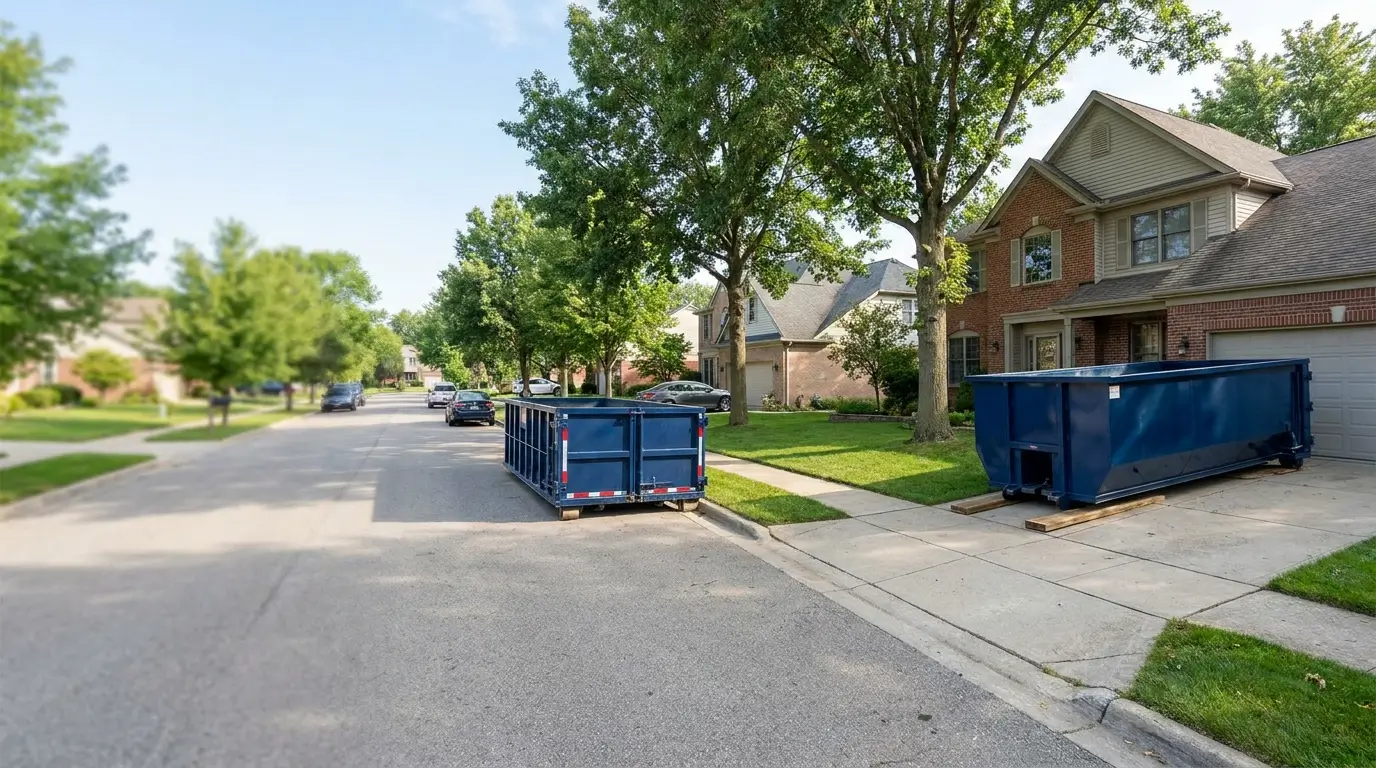
Ask about protective boards
Some providers use wooden boards or other protective materials beneath the container or at contact points.
These may help distribute pressure and reduce direct contact with the surface.
However, protective boards do not guarantee that a driveway will remain undamaged.
Discuss the provider’s protection procedure before delivery.
Inspect the surface before delivery
Walk through the proposed placement area and photograph its condition.
Look for:
- Existing cracks
- Broken concrete
- Uneven pavement
- Loose pavers
- Soft asphalt
- Drainage problems
- Areas that may not support heavy equipment
Having photographs can help document the driveway’s condition before the container arrives.
Avoid weak or uneven locations
A steep, soft, or unstable surface may create problems during delivery and pickup.
If the driveway has a questionable section, ask the provider whether another location is more appropriate.
Consider the weight of the project
A dumpster filled with lightweight household junk is different from one loaded with concrete, roofing shingles, brick, or other dense materials.
Heavy debris can increase the load placed on the container and delivery equipment.
Confirm the provider’s weight restrictions and discuss the intended material before loading.
8. What If Your Driveway Is Too Small?
Not every Warren property has a large driveway.
Some homes have short driveways, narrow entrances, detached garages, or limited parking space.
If your driveway cannot accommodate a suitable container, consider the following steps.
Ask about smaller containers
A smaller dumpster may fit in an acceptable placement area when a larger container cannot.
For example, a 10-yard or 15-yard container may be easier to accommodate than a 30-yard container.
However, the smaller container must still comply with the City’s placement rules.
Consider a different part of the property
Depending on the property layout, another suitable area may be available.
Possibilities could include an approved side or rear area with adequate access.
Before arranging delivery, verify:
- Whether the location is permitted
- Whether the ground can support the container
- Whether the delivery truck can reach it
- Whether fences or landscaping create obstacles
- Whether access to neighboring properties remains clear
Coordinate the delivery with the project
If the available space is limited, schedule the dumpster for the period when it is most useful.
For example, a homeowner may be able to arrange delivery immediately before demolition begins rather than keeping the container on the property for longer than necessary.
Discuss the rental period and pickup arrangements with the provider.
Do not use the sidewalk as an automatic alternative
A sidewalk is part of the public pedestrian route. Placing a dumpster there can obstruct accessibility and create safety concerns.
Do not treat the sidewalk, grass strip, or roadside area as an alternative storage location without explicit confirmation from the City.
9. What About Corner Lots and Narrow Residential Streets?
Corner properties and narrow streets can create additional placement challenges.
A dumpster that fits comfortably on a standard driveway may be difficult to position near a corner, intersection, or narrow access road.
Corner-lot considerations
Before arranging delivery at a corner property, consider:
- Visibility near the intersection
- Sidewalk access
- Street signs
- Traffic movement
- Driveway entrances
- Utility poles and equipment
- Public easements
Even when the container is on private property, its position should not create an obstruction or visibility problem.
Narrow streets
A delivery truck needs sufficient room to maneuver.
If vehicles are regularly parked along both sides of a narrow street, the provider may need additional information before confirming delivery.
Tell the provider if:
- The street has limited width.
- Vehicles commonly park near the driveway.
- The driveway entrance is narrow.
- Large trees restrict access.
- The property is located on a tight curve.
Do not assume the truck can move parked vehicles or temporarily occupy neighboring property.
Shared driveways
Some properties have shared driveways or access arrangements.
Before placing a dumpster in a shared area, confirm that the location does not interfere with another property’s access and obtain any necessary agreement from the people who use the space.
10. Can You Put a Dumpster on Your Lawn?
A lawn may appear to offer additional space when the driveway is unsuitable.
However, placing a roll-off container on grass can create problems.
The weight of the container and delivery equipment may damage the lawn, compact the soil, create ruts, or disturb irrigation and drainage features.
Potential lawn damage
A heavy dumpster can cause:
- Compressed soil
- Damaged grass
- Deep tire tracks
- Uneven ground
- Damaged sprinkler lines
- Disturbed landscaping
Wet ground can increase the likelihood of these problems.
Check the ground condition
Before considering lawn placement, assess whether the area is firm, level, and accessible.
Ask the provider whether its equipment can reach the location without crossing weak ground or damaging landscaping.
Confirm that the location is allowed
A lawn is part of the property, but that alone does not establish that the proposed dumpster location complies with Warren’s placement restrictions.
The building-line requirement under Section 97.13 still needs to be considered.
Do not assume that moving the dumpster from the driveway to the front lawn solves a placement issue.
11. Keep Sidewalks, Driveways, and Public Access Clear
Wherever a dumpster is positioned, maintaining safe access is essential.
A container should not create an unnecessary obstruction for residents, neighbors, pedestrians, or service vehicles.
Keep sidewalks accessible
Pedestrians should not have to walk around a dumpster or enter the roadway because a container blocks the sidewalk.
This is particularly important for people using wheelchairs, walkers, strollers, or other mobility equipment.
Keep neighboring driveways clear
Avoid positioning a container where it blocks access to another property.
If the dumpster is close to a shared property line, verify that there is sufficient room for neighboring vehicles and residents.
Avoid blocking utility equipment
Do not obstruct access to:
- Water meters
- Utility boxes
- Fire hydrants
- Electrical equipment
- Drainage structures
- Other service infrastructure
These facilities may need to remain accessible during the rental period.
Prevent debris from spreading
Wind can scatter lightweight waste from an uncovered dumpster.
Use the provider’s recommended loading and covering procedures, and do not allow debris to spill onto neighboring property or public areas.
12. Does Dumpster Size Affect Where You Can Put It?
Yes. Container size can affect placement feasibility.
A 10-yard dumpster has a different footprint from a 30- or 40-yard container. Larger containers generally require more space, and delivery equipment also needs sufficient room.
The correct size depends on both the project and the property.
| Dumpster size | General placement consideration |
|---|---|
| 10-yard | May be easier to accommodate in a smaller approved area |
| 15-yard | Requires additional footprint compared with smaller containers |
| 20-yard | Needs more room for placement and access |
| 30-yard | Requires substantial space and careful access planning |
| 40-yard | May be unsuitable for properties with limited access or placement space |
Actual dimensions vary by provider and container design.
Ask for the container dimensions
Before delivery, request the container’s approximate:
- Length
- Width
- Height
- Delivery clearance requirements
Do not rely only on the yard size when estimating whether a dumpster will fit.
Consider loading access
A container may fit in a location but still be inconvenient to use.
For example, a dumpster placed behind a garage may require workers to carry debris through a narrow passage.
A suitable location should provide enough room for safe loading as well as delivery and pickup.
For more sizing information, read 10 vs 15 vs 20 Yard Dumpster: Which One Do You Need? and 20 Yard vs 30 Yard Dumpster for Remodels and Cleanouts.
13. How to Prepare Your Property Before Dumpster Delivery
Preparing the placement area in advance can help avoid delays and make the delivery process smoother.
Step 1: Confirm the proposed location
Identify where the container will go and check the City’s requirements.
Do not schedule delivery based solely on the assumption that private property automatically permits every placement position.
Step 2: Measure the area
Measure the available length and width, then compare them with the container dimensions provided by the rental company.
Remember to account for delivery equipment and access clearance.
Step 3: Move vehicles and obstacles
Before delivery:
- Move parked vehicles.
- Open gates if needed.
- Clear equipment and tools.
- Remove low-hanging obstructions where appropriate.
- Keep the driveway entrance accessible.
Step 4: Discuss surface protection
Tell the provider about the driveway’s condition and ask whether protective boards or another placement method is recommended.
Step 5: Confirm the material type
Explain what you plan to put in the dumpster.
Construction debris, household junk, yard waste, concrete, and roofing materials may have different weight and acceptance requirements.
Step 6: Confirm delivery and pickup arrangements
Make sure you understand the expected delivery window, rental duration, and pickup procedure.
If the project schedule changes, contact the provider before the scheduled pickup.
14. Common Dumpster Placement Mistakes to Avoid
Even a correctly sized dumpster can create problems if its location is not properly planned.
Assuming every driveway location is allowed
Warren’s Section 97.13 includes a restriction concerning placement in front of the building line closest to the street.
Check the exact location rather than relying on a general assumption about private property.
Placing the dumpster on the street without confirmation
A public street or right-of-way is not an automatic alternative when a driveway is unavailable.
Warren’s code restricts non-city-served dumpsters on public rights-of-way.
Confirm whether any lawful alternative arrangement exists before ordering.
Blocking a sidewalk
A blocked sidewalk can force pedestrians into the roadway and create accessibility problems.
Keep public walking routes clear.
Underestimating delivery clearance
The container may fit in the available space, but the delivery truck may not be able to position it safely.
Give the provider accurate access measurements and information about obstacles.
Ignoring the building line
This is particularly important in Warren because the City’s placement rule specifically addresses the building line closest to the street.
Ask for clarification if you are unsure where the proposed container would sit in relation to it.
Forgetting about surface protection
A damaged or weak driveway may be more vulnerable to pressure from the container and delivery equipment.
Discuss protection before delivery rather than after damage occurs.
Choosing a container that is too large
A larger dumpster may be unnecessary for a small project and more difficult to accommodate.
Compare the debris volume with the available placement area before selecting a size.
15. Questions to Ask Before Renting a Dumpster in Warren
Before finalizing your rental arrangement, ask the provider these questions:
- What are the exact dimensions of the container?
- How much clearance does the delivery truck need?
- Can you review my proposed placement location?
- Does the proposed location comply with Warren’s placement restrictions?
- Can the container be positioned without blocking access?
- Do you provide driveway protection?
- What materials can I place inside?
- What is the included weight allowance?
- How long can I keep the dumpster?
- What happens if the scheduled pickup needs to change?
Also ask whether the provider can help clarify the local placement process.
A provider familiar with Warren may be able to explain common delivery considerations, but the City is the appropriate authority for interpreting its municipal requirements.
16. Where to Get Official Dumpster Placement Information in Warren
For questions involving dumpster placement, public rights-of-way, and local code requirements, consult official City information rather than relying exclusively on general dumpster rental advice.
Useful resources include:
City of Warren Municipal Code
The municipal code contains the local rules governing dumpsters and other property-related requirements. Review Section 97.13, which addresses roll-off and front-load dumpsters.
Official City code access: City of Warren Code of Ordinances.
City of Warren Planning Department
The Planning Department provides zoning information and access to the City’s zoning ordinance. Contact the department at (586) 574-4687 for applicable zoning questions.
City of Warren Planning Department.
City of Warren Engineering and Right-of-Way Information
The City’s Engineering resources cover streets, sidewalks, public rights-of-way, and related infrastructure questions.
City of Warren Street and Road Issues.
If you are uncertain whether a proposed dumpster location is permitted, explain that it is a privately rented roll-off container and provide the property address and proposed placement area.
Do not assume that a general right-of-way permit or construction approval automatically authorizes dumpster placement.
17. How Warren Dumpster Rental Can Help With Placement Planning
Choosing a dumpster is only one part of arranging waste removal. You also need to identify a suitable location, confirm access, understand container dimensions, and make sure the proposed placement complies with applicable local requirements.
Warren Dumpster Rental helps connect customers with independent dumpster rental providers serving Warren, Michigan, and nearby communities where coverage is available.
The matched provider handles availability, rental arrangements, pricing, billing, delivery, and pickup.
When requesting information, explain:
- Whether you plan to use a driveway or another private-property location
- The approximate available placement dimensions
- Whether the property has a narrow entrance
- Whether there are low branches or overhead obstructions
- Which dumpster size you are considering
- What type of waste you plan to load
If you are unsure whether the location complies with Warren’s rules, confirm that issue with the City before scheduling delivery.
A little planning can help avoid unnecessary changes and make the rental process easier to coordinate.
Frequently Asked Questions
Can I put a dumpster in my driveway in Warren, MI?
A suitable private-property location may be possible, but homeowners should check Warren City Code Section 97.13. The provision restricts non-city-served dumpsters from being placed in front of the building line closest to the street. Confirm the exact proposed location with the City and provider before delivery.
Can I put a dumpster on the street in Warren?
Warren City Code Section 97.13 restricts non-city-served roll-off dumpsters on public rights-of-way. Do not assume that ordinary street placement is allowed or that a general permit automatically creates an exception. Confirm the rules with the City before arranging delivery.
Does a dumpster on private property need a permit in Warren?
Permit requirements and placement restrictions are not the same thing. Even when a dumpster is on private property, its location must comply with applicable City rules, including Section 97.13. Confirm the proposed location rather than assuming that private ownership makes every position acceptable.
What is Warren City Code Section 97.13?
Section 97.13 addresses roll-off and front-load dumpsters. Its non-city-served provision includes restrictions on placing these containers in front of a business or residence, in front of the building line closest to the street, or on a public right-of-way.
Can I put a dumpster on my front lawn?
Do not assume that a front lawn is an acceptable alternative to driveway or street placement. The City’s building-line restriction still needs to be considered. Confirm the proposed location with the City before delivery.
Can I put a dumpster on the sidewalk?
Do not place a dumpster on a sidewalk without explicit authorization from the appropriate City authority. Sidewalks need to remain accessible for pedestrians, including people using mobility devices.
What if my driveway is too small for a dumpster?
Ask the provider whether a smaller container is available and whether another suitable private-property location can be used. If no compliant placement area is available, contact the City about the applicable restrictions and possible alternatives. Do not automatically move the dumpster into the street.
Can a dumpster block part of my driveway?
A dumpster should be positioned so that essential access remains available whenever possible. Consider garage doors, vehicle movement, entrances, and emergency access before selecting a location.
How much space does a roll-off dumpster need?
The required space depends on the container size and delivery equipment. Ask the provider for the exact dimensions and clearance requirements. A container may fit in a driveway while the delivery truck still lacks enough room to position it safely.
Will a dumpster damage my driveway?
Damage is possible depending on the driveway’s condition, the container’s weight, and the delivery equipment. Ask about protective boards or other surface-protection methods. Photograph existing cracks and damage before delivery.
Can I put a dumpster on a shared driveway?
Only consider a shared driveway if the proposed location is appropriate, access remains clear, and any necessary agreement with the other property users has been obtained. Also confirm that the location complies with Warren’s placement requirements.
Can I place a dumpster behind my house?
A rear or side location may be worth considering if the property layout and delivery access allow it. However, the container must still comply with applicable City rules. Ask the City and provider to confirm the proposed location.
Who should I contact if I am unsure about dumpster placement in Warren?
Start with the City of Warren’s Planning Department or the appropriate Engineering or code-enforcement office, depending on the question. Provide the property address and explain that you are asking about a privately rented roll-off dumpster under Section 97.13.
Final Thoughts
Choosing the right dumpster location is an important part of planning a home improvement or cleanup project in Warren, Michigan.
A suitable private-property location may offer convenient loading and reduce interference with public access. However, homeowners must pay attention to Warren City Code Section 97.13, particularly its restrictions on the location of non-city-served dumpsters in relation to the building line and public rights-of-way.
Street placement should never be assumed to be available simply because a driveway is too small. Confirm the City’s requirements before arranging delivery.
Measure the available space, check access and overhead clearance, discuss surface protection, and select a container that fits both your project and your property.
Taking these steps before delivery can help prevent placement problems and make your dumpster rental easier to manage.