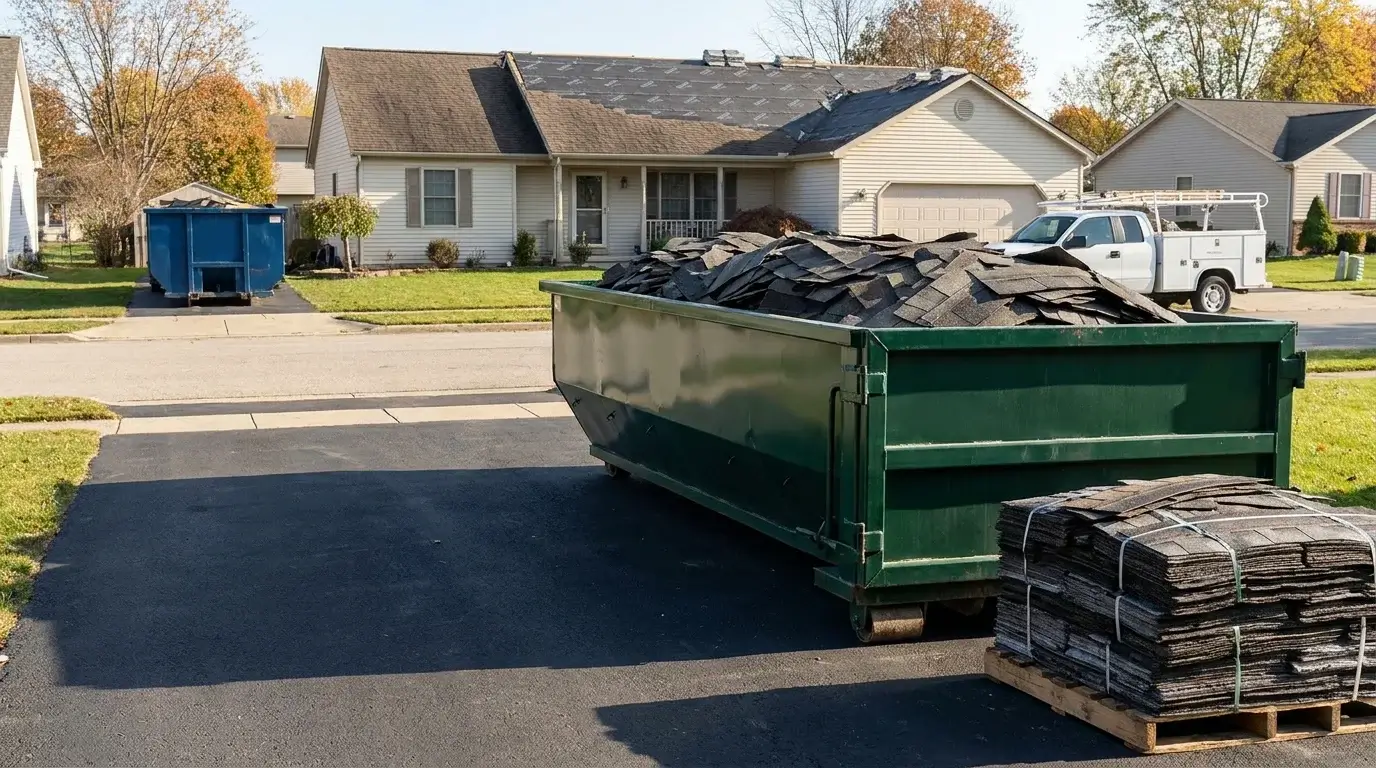
Replacing a roof creates a surprising amount of debris. Even an average-sized residential roof can produce thousands of pounds of old shingles, underlayment, nails, flashing, and other materials. If the project also involves removing damaged roof decking or multiple layers of existing shingles, the total waste can become much heavier.
Choosing a dumpster for a roofing project is different from choosing one for a garage cleanout or general household junk removal. With roofing debris, weight can become a problem before the container is full. A large dumpster may provide plenty of room, but that does not necessarily mean it can safely carry the entire roofing load within its included weight allowance.
For homeowners, roofing contractors, and property managers planning a roof replacement in Warren, Michigan, understanding shingle weight is an important part of arranging waste disposal. The right container depends on the roof’s size, the type of shingles, the number of layers being removed, and the weight limit established by the rental provider.
This roofing dumpster guide explains how to estimate shingle debris, understand roofing squares, compare container sizes, and plan a tear-off without unnecessary delays or unexpected weight charges.
Why Roofing Projects Need a Different Dumpster Plan
Roofing waste has two characteristics that make dumpster selection particularly important: it is heavy, and it can accumulate quickly.
Household junk often contains a mixture of lightweight items such as cardboard, clothing, packaging, and furniture. Roofing debris is different. Asphalt shingles contain asphalt, fiberglass, mineral granules, and other materials that create a relatively dense waste load.
A roofing crew may remove several hundred square feet of shingles in a short period. As the material comes off the roof, it needs to be collected and transported away from the work area. If the dumpster is too small, the crew may need to stop working while another container is arranged.
There are several reasons to plan the container carefully:
- High material weight: Asphalt shingles can weigh several hundred pounds per roofing square.
- Multiple roof layers: Removing two or three layers increases the total debris weight substantially.
- Additional materials: Underlayment, flashing, nails, damaged decking, and other components add to the load.
- Weight allowances: Dumpster providers establish maximum weight limits and may charge additional fees when those limits are exceeded.
- Project scheduling: A container that fills or reaches its weight limit too early can interrupt the roofing schedule.
The goal is not simply to order the largest dumpster available. It is to match the container’s physical capacity and weight allowance to the actual roofing project.
Understanding Roofing Squares Before Ordering a Dumpster
Roofing contractors generally measure roof coverage in squares rather than counting individual shingles or measuring the entire roof in ordinary square feet.
One roofing square represents 100 square feet of roof surface.
For example:
| Roof area | Roofing squares |
|---|---|
| 1,000 sq. ft. | 10 squares |
| 1,500 sq. ft. | 15 squares |
| 2,000 sq. ft. | 20 squares |
| 2,500 sq. ft. | 25 squares |
| 3,000 sq. ft. | 30 squares |
| 3,500 sq. ft. | 35 squares |
These figures represent actual roof surface area, not necessarily the home’s ground-level footprint.
A sloped roof has more surface area than the building footprint beneath it. Roof pitch, overhangs, dormers, valleys, and other architectural features affect the total area.
If a roofing contractor has already calculated the roof in squares, ask for that measurement before arranging a dumpster. It provides a useful starting point for estimating the quantity of shingles that will be removed.
If you only know the home’s footprint, do not assume it equals the roof area. Ask the roofing contractor to provide the estimated tear-off area.
How Much Do Asphalt Shingles Weigh?
Shingle weight varies by manufacturer, product design, material composition, and construction.
Standard three-tab shingles are generally lighter than many architectural or premium laminated products. Architectural shingles contain additional material and are usually heavier per roofing square.
For preliminary planning, the following approximate ranges can help:
| Shingle type | Approximate weight per square |
|---|---|
| Three-tab asphalt shingles | 200–240 lbs. |
| Architectural asphalt shingles | 211–300 lbs. |
| Heavy designer asphalt shingles | 350–468 lbs. |
These are approximate product-weight references, not guaranteed weights for every roof tear-off. Actual discarded material may include underlayment, nails, flashing, moisture, and other debris.
The National Institute of Standards and Technology’s building-material assessment uses an average asphalt-shingle weight of approximately 222 pounds per square. Roofing industry references also show that asphalt-shingle weights vary considerably by product and construction.
For a practical dumpster estimate, it is sensible to use a range rather than assuming every square weighs exactly the same amount.
Three-tab asphalt shingles
Three-tab shingles are a traditional asphalt roofing product. They generally have a flatter appearance and a single-layer design.
For planning purposes, a square of three-tab shingles may weigh approximately 200–240 pounds.
A 20-square roof with one layer of these shingles could therefore produce roughly:
- 20 squares × 200 lbs. = 4,000 lbs.
- 20 squares × 240 lbs. = 4,800 lbs.
That is approximately 2–2.4 tons of shingles before accounting for additional roofing materials.
Architectural asphalt shingles
Architectural shingles, sometimes called dimensional or laminated shingles, have a thicker, layered construction.
Their additional material can make them heavier than traditional three-tab products. A planning range of approximately 211–300 pounds per square illustrates the variation between products.
For a 20-square roof, that could mean approximately 4,220–6,000 pounds of shingle debris alone.
This difference matters when the dumpster has a limited included tonnage allowance.
Premium and designer shingles
Some premium asphalt shingles are substantially heavier than standard products. They may be designed to create a slate-like or wood-shake appearance.
For these products, a standard three-tab weight assumption could underestimate the debris load.
If the roof has a premium or specialty shingle, ask the contractor for the product name or approximate weight per square. The information on the original packaging or manufacturer’s product documentation can help produce a more reliable estimate.
How Much Do Old Roofing Shingles Weigh After Tear-Off?
The weight of the discarded roofing material is not always identical to the published weight of new shingles.
A tear-off can include:
- Asphalt shingles
- Roofing felt or synthetic underlayment
- Nails and staples
- Drip edge and flashing
- Ridge caps and starter strips
- Small pieces of damaged roof decking
- Other construction debris
Some roofing projects also involve removing old shingles that have been exposed to years of weather. Moisture and accumulated debris can affect the load.
For an initial estimate, calculate the shingle weight first and then allow for additional materials.
For example, consider a 25-square roof with architectural shingles estimated at 250 pounds per square:
25 × 250 = 6,250 pounds
That equals approximately 3.13 tons of shingles alone.
If the crew also removes underlayment, flashing, and damaged wood, the final dumpster load will weigh more.
This is why a contractor should not estimate the entire disposal requirement using shingle weight alone.
Why Multiple Layers of Shingles Change the Dumpster Size
One of the most important questions before ordering a roofing dumpster is whether the existing roof has one layer or multiple layers of shingles.
Some older roofs have a second layer installed over the original roofing material. A tear-off may therefore involve removing more material than the visible top layer suggests.
If two layers are removed, the shingle portion of the debris may be approximately twice the weight of a single-layer roof of the same size. Three layers can increase it further.
Consider a 20-square roof using shingles estimated at 250 pounds per square:
| Number of layers | Estimated shingle weight |
|---|---|
| One layer | 5,000 lbs. |
| Two layers | 10,000 lbs. |
| Three layers | 15,000 lbs. |
These figures are simplified planning calculations. Different layers may contain different shingle products, and additional debris is not included.
Multiple layers can change the container recommendation significantly. A dumpster that would work for a single-layer tear-off may exceed its weight allowance when two layers are removed.
Before scheduling delivery, ask the roofing contractor whether the existing roof has multiple layers and whether the entire roof covering will be removed.
Choosing the Right Dumpster Size for Roofing Debris
Dumpster sizes are usually described by volume in cubic yards. However, roofing projects require attention to both volume and weight.
A 10-yard dumpster may be more suitable than a 30-yard dumpster for certain heavy-material projects because the smaller container can help keep the load within an appropriate weight range.
The following sections explain how common sizes may fit different roofing projects.
10-Yard Dumpster for Small Roofing Projects
<Add image: 10-yard roll-off dumpster beside a small residential roof replacement project.>
A 10-yard dumpster can be a useful option for smaller roofing jobs, such as:
- Detached garage roof replacement
- Small shed roofing projects
- Porch or patio roof repairs
- Small additions
- Limited roof sections
- Minor roofing tear-offs
Its relatively low height and compact capacity may also be helpful when driveway space is limited.
However, the container’s included weight allowance is just as important as its size. Even a relatively small roof can generate several thousand pounds of shingles.
Before choosing a 10-yard dumpster, confirm how many tons are included and whether the provider has a roofing-specific weight limit.
15-Yard Dumpster for Moderate Roofing Jobs
A 15-yard container can provide additional volume without moving immediately to a much larger dumpster.
It may be worth considering for:
- Moderate residential roof replacements
- Larger garage roofs
- Small homes with uncomplicated roof layouts
- Projects involving additional roofing materials
- Jobs where a provider recommends a smaller container with a planned swap-out
The 15-yard option is not offered by every provider, and weight allowances differ. Ask about availability and the permitted roofing debris weight.
For dense shingle loads, a 15-yard container can still reach its weight limit before the available space is used.
20-Yard Dumpster for Many Residential Roofing Projects
<Add image: 20-yard roll-off dumpster positioned near a residential roofing replacement project.>
A 20-yard dumpster is a common size to discuss when planning a residential roof replacement.
It provides more volume for shingles, underlayment, flashing, and other materials. Depending on the roof size and the provider’s weight allowance, it may be suitable for projects such as:
- Standard single-family roof replacement
- Medium-sized homes
- Larger garage and house combinations
- Roofing projects with additional tear-off materials
- Some multi-section roof replacements
However, a 20-yard container is not automatically suitable for every medium-sized roof.
A 20-yard dumpster with a two-ton allowance may not be appropriate for a roof that produces more than three tons of shingle debris. In that situation, the project may need a different weight arrangement or a planned container exchange.
Always compare the estimated debris weight with the provider’s included tonnage.
30-Yard Dumpster for Larger Roofing Projects
<Add image: 30-yard roll-off dumpster at a large residential renovation or roofing project.>
A 30-yard dumpster provides more physical capacity and can be useful when the roofing project produces a large volume of debris.
Possible applications include:
- Large residential roof replacements
- Multiple-building roofing projects
- Extensive tear-offs with additional construction debris
- Projects involving roof decking and other bulky materials
- Larger contractor jobs
The important limitation is that more cubic yards do not automatically mean more allowable weight.
A 30-yard dumpster may have a higher weight allowance than a smaller container, but this depends on the provider’s terms. A large container filled with asphalt shingles can become extremely heavy.
If the project is mainly shingles, ask whether a smaller container with a planned swap-out would be more appropriate.
40-Yard Dumpster for Large Construction and Roofing Projects
A 40-yard container offers substantial volume and may be useful for larger construction projects or roofing jobs that include bulky, relatively lightweight materials.
For example, a large project involving roofing, packaging, insulation, and other renovation debris may benefit from the additional space.
However, it is not necessarily the best choice for a large quantity of dense shingles.
A full 40-yard container of roofing debris may exceed the permitted weight limit long before it reaches the top. The provider may also restrict how much heavy roofing material can be loaded.
For large tear-offs, ask about maximum permitted weight, container exchanges, and whether a roofing-specific arrangement is available.
Dumpster Size Comparison for Roofing Projects
The following table provides a general starting point. It does not establish guaranteed roof-square limits because dumpster dimensions, weight allowances, and acceptable materials vary by provider.
| Dumpster size | Possible roofing applications | Important consideration |
|---|---|---|
| 10 yard | Small roofs, garages, additions | Confirm weight allowance carefully |
| 15 yard | Moderate roof sections and residential jobs | Availability varies |
| 20 yard | Many medium residential projects | Compare shingle weight with included tonnage |
| 30 yard | Larger roofs and mixed renovation debris | More volume does not remove weight restrictions |
| 40 yard | Large construction and bulky debris projects | Dense shingles can reach weight limits early |
The best size depends on the actual tear-off area, shingle type, number of layers, additional materials, and the provider’s rules.
How to Calculate the Estimated Weight of Roofing Debris
You do not need specialized software to create a preliminary roofing debris estimate.
Start with the roof area in squares, determine the approximate shingle weight per square, and multiply the two numbers.
Basic formula:
Estimated shingle weight = Roof squares × Weight per square
For example, suppose a roof measures 24 squares and contains architectural shingles estimated at 250 pounds per square.
24 × 250 = 6,000 pounds
The estimated shingle weight is approximately 6,000 pounds, or 3 tons.
Next, consider whether the crew will remove additional materials.
The calculation should account for:
- Total roof squares
- Shingle type
- Number of layers
- Underlayment and roofing accessories
- Damaged decking or other construction materials
- Any additional material the provider allows in the container
If there are two layers, calculate each layer separately when the shingle types are different.
Example: A 15-Square Roof
Assume a 15-square roof has one layer of three-tab shingles estimated at 220 pounds per square.
15 × 220 = 3,300 pounds
That is approximately 1.65 tons of shingles before additional debris.
A dumpster with a two-ton included allowance might appear sufficient based on this calculation, but the remaining capacity could be limited once underlayment and other materials are included.
The contractor should confirm the expected total load and the provider’s weight allowance.
Example: A 25-Square Roof
Now consider a 25-square roof with architectural shingles estimated at 275 pounds per square.
25 × 275 = 6,875 pounds
That equals approximately 3.44 tons of shingles.
If the roof contains two layers, the shingle weight could be roughly 6.88 tons before additional materials.
This is a situation where choosing a container based only on cubic-yard capacity could lead to a costly mistake.
What Other Roofing Materials Add to the Load?
Shingles are usually the main source of roofing tear-off weight, but they are not the only materials that may enter the dumpster.
Roofing felt and underlayment
Older roofs may contain asphalt-saturated felt, while newer systems may use synthetic or self-adhering underlayment.
These materials add weight, although generally less than the shingles themselves.
The amount depends on the type of underlayment and the number of layers being removed.
Roofing nails and fasteners
Nails and other fasteners may seem insignificant individually, but they accumulate across an entire roof.
They are normally part of the overall roofing debris load.
Flashing and drip edge
Metal flashing, drip edge, and other roof accessories are usually lighter than the main shingle load, but their weight should still be considered.
Some providers may have rules for separating or disposing of particular materials.
Roof decking and plywood
Damaged plywood or OSB roof decking can add substantial weight.
A project that begins as a shingle replacement may become a larger construction cleanup if the contractor discovers water damage or deteriorated wood.
For example, replacing multiple sheets of roof decking creates additional bulky material that may change the container requirements.
Ask the roofing contractor whether decking replacement is expected or whether it will be handled only if damaged sections are discovered.
Insulation and other construction debris
Some roofing and renovation projects also involve insulation, fascia, soffit, trim, and other building materials.
These materials can increase the volume of the load and may have separate disposal restrictions.
Confirm accepted materials before mixing them with shingles.
What Happens When a Roofing Dumpster Exceeds Its Weight Limit?
A dumpster has a maximum permitted weight that applies to the container and its contents under the provider’s transportation and disposal requirements.
The included weight allowance is often part of the rental arrangement.
If the final load exceeds that allowance, additional charges may apply. These are commonly described as overweight or overage fees.
For example, suppose a rental agreement includes two tons, but the final load weighs 3.2 tons.
The load is 1.2 tons over the included allowance.
The provider’s pricing terms determine how the extra weight is calculated and billed.
Potential consequences include:
- Additional disposal charges
- Delays while the load is assessed
- A requirement to remove excess material
- A container exchange or alternative disposal arrangement
- Scheduling complications if the container cannot be transported as loaded
Never assume that the provider will accept an overloaded container simply because the debris fits inside it.
Ask for the included tonnage and overage rate before booking.
For more detail, see our related guide: Dumpster Overage Fees: How Weight Limits Affect Your Final Bill.
Why a Larger Dumpster Is Not Always Better for Roofing
It may seem logical to order the largest container available so the entire roof can be removed without worrying about space.
That approach does not always work well for shingle disposal.
Roofing debris is dense, and transportation weight limits remain important regardless of container size.
Consider two possible arrangements:
- A large container with a relatively low weight allowance
- A smaller container with an appropriate allowance and a planned exchange
Depending on the project, the second arrangement may be more practical.
A smaller container can also make it easier to manage the amount of dense debris placed in one load.
The important point is to compare both volume and weight rather than treating dumpster size as the only measure of capacity.
When Should You Arrange a Dumpster Exchange?
A container exchange may be useful when a roofing project produces more debris than one load can accommodate.
Instead of trying to fit the entire tear-off into one container, the contractor can arrange for a full container to be removed and another one delivered.
A planned exchange may be worth discussing when:
- The roof has multiple shingle layers.
- The project covers a large number of roofing squares.
- The contractor expects additional decking replacement.
- The provider’s weight allowance is lower than the estimated debris weight.
- The roofing schedule requires continuous debris removal.
Arrange the exchange in advance whenever possible.
Do not wait until the container is overloaded or completely full to contact the provider. Pickup and replacement availability can affect the project’s schedule.
Preparing Your Property for a Roofing Dumpster
The dumpster location matters just as much as its size.
A roofing project can involve trucks, trailers, ladders, material deliveries, and workers moving around the property. The container should be placed where the crew can load it efficiently without creating unnecessary access problems.
Choose a suitable placement area
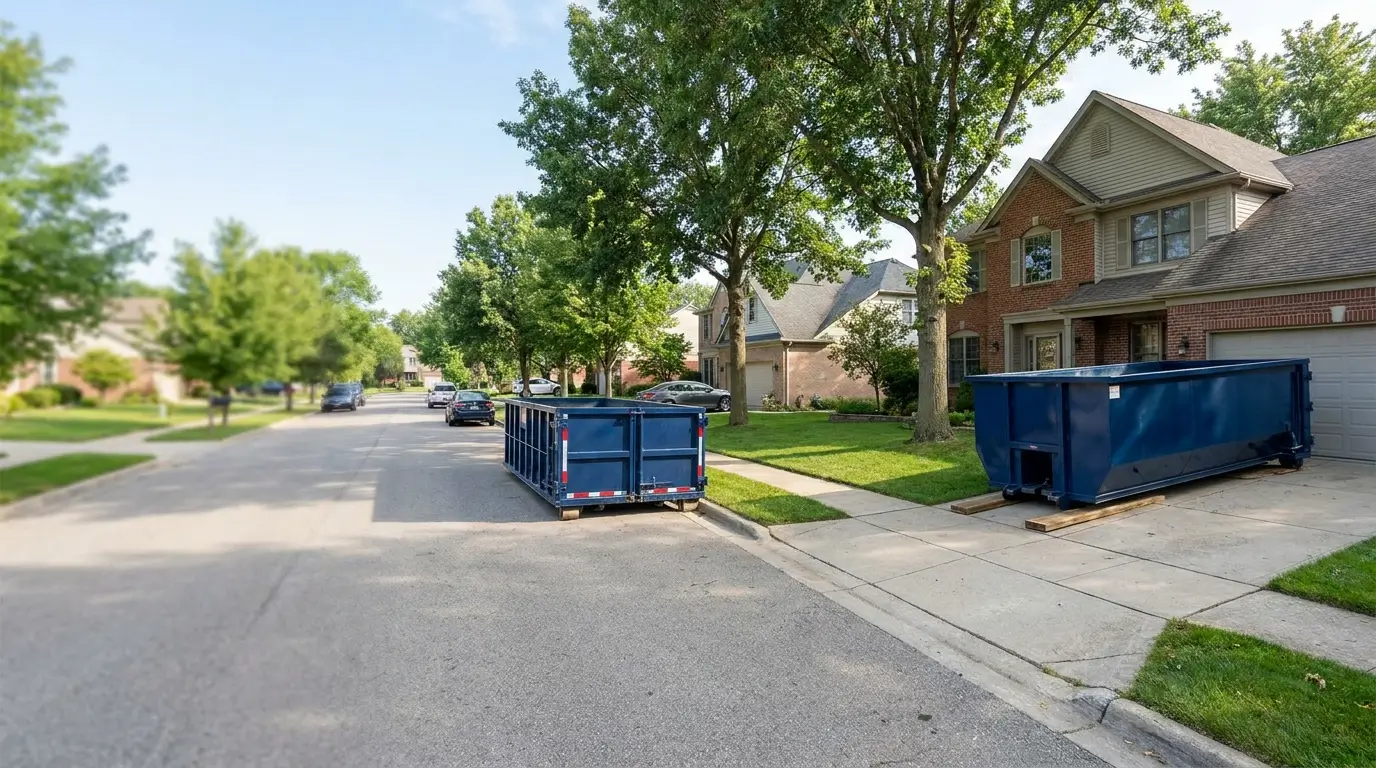
A driveway is often considered first because it can provide convenient access.
Before delivery, check:
- Available driveway length and width
- Ground condition and slope
- Space required for the delivery truck
- Overhead tree branches and utility lines
- Access to garages and other entrances
- Clearance for the roofing crew and equipment
Do not assume that every driveway can accommodate every dumpster size.
Protect the driveway surface
A loaded dumpster can place significant pressure on the surface beneath it.
Ask the provider whether boards or other protective materials are recommended. Some providers may offer placement protection, while others may require the customer or contractor to prepare the area.
The condition of the driveway also matters. Older concrete, asphalt, decorative paving, and uneven surfaces may require extra consideration.
For more information, see our related page on Driveway-Safe Rentals.
Check local placement requirements in Warren
Before arranging delivery in Warren, Michigan, verify where the dumpster can legally be placed.
A private driveway and a public street are not necessarily treated the same way. Public right-of-way placement may be restricted, and permission should not be assumed.
The property owner or contractor should confirm applicable requirements with the City of Warren and the dumpster provider before delivery.
The safest approach is to establish the exact placement location in advance rather than moving a container after it arrives.
Roofing Dumpster Loading Tips
Proper loading helps make the best use of the container and reduces the chance of an uneven or unsafe load.
Load shingles evenly
Avoid creating one extremely heavy pile in a single area of the container.
Distribute material across the available floor space as the project progresses, following the provider’s loading instructions.
Keep debris below the fill line
Most roll-off containers have a maximum fill line or require the load to remain level with the top edge.
Do not stack shingles above the container walls or allow material to hang over the sides.
An overloaded container may not be safe or legal to transport.
Separate materials when required
Some providers may require roofing shingles to be kept separate from other debris.
If the project includes metal, wood, insulation, or other materials, ask whether they can be combined in the same container.
Do not add unapproved materials
A roofing dumpster is not automatically suitable for every type of construction waste.
Paint, chemicals, batteries, propane cylinders, asbestos-containing materials, and other restricted items may require separate handling.
Always obtain approval before placing unfamiliar materials in the dumpster.
How to Avoid Unexpected Roofing Dumpster Costs
Roofing projects already involve several expenses, including labor, materials, underlayment, flashing, and possible decking repairs.
Poor dumpster planning can add avoidable disposal costs.
These steps can help:
1. Confirm the roof size
Ask the roofing contractor for the estimated number of squares being removed.
Do not rely only on the home’s footprint.
2. Find out how many layers are present
A second layer can significantly increase the amount of debris.
Make sure the container estimate accounts for every layer being removed.
3. Identify the shingle type
Three-tab, architectural, and premium shingles do not all weigh the same.
Use a reasonable product-specific estimate when possible.
4. Ask about included weight
Confirm the exact tonnage allowance for the proposed container.
Do not assume that a larger container includes unlimited disposal weight.
5. Understand overage charges
Ask how additional weight is measured and billed.
Also ask whether the provider uses a minimum billing increment or another calculation method.
6. Confirm rental duration
Roofing projects can experience delays because of rain, material deliveries, or unexpected repairs.
Find out how many rental days are included and what additional days cost.
7. Plan for additional debris
If the contractor may replace roof decking, fascia, or other materials, include those possibilities in the estimate.
8. Get the rental terms in writing
Confirm the container size, included tonnage, accepted materials, rental period, pickup arrangements, and additional charges.
For more cost-saving ideas, read 7 Ways to Lower Your Dumpster Rental Bill.
Roofing Dumpster Rental Planning for Warren, MI
Homeowners and contractors in Warren should plan roofing waste disposal around the size of the project, the property layout, and the rental provider’s requirements.
The right arrangement may differ between a small garage roof and a complete residential replacement.
For example:
- A small garage tear-off may be suitable for a compact container.
- A standard home roof replacement may require a 15-yard or 20-yard option, depending on weight.
- A large roof with multiple layers may need a different weight arrangement or planned container exchanges.
- A project involving extensive roof decking replacement may require additional volume and weight capacity.
Warren property owners should also consider driveway access and local placement requirements before scheduling delivery.
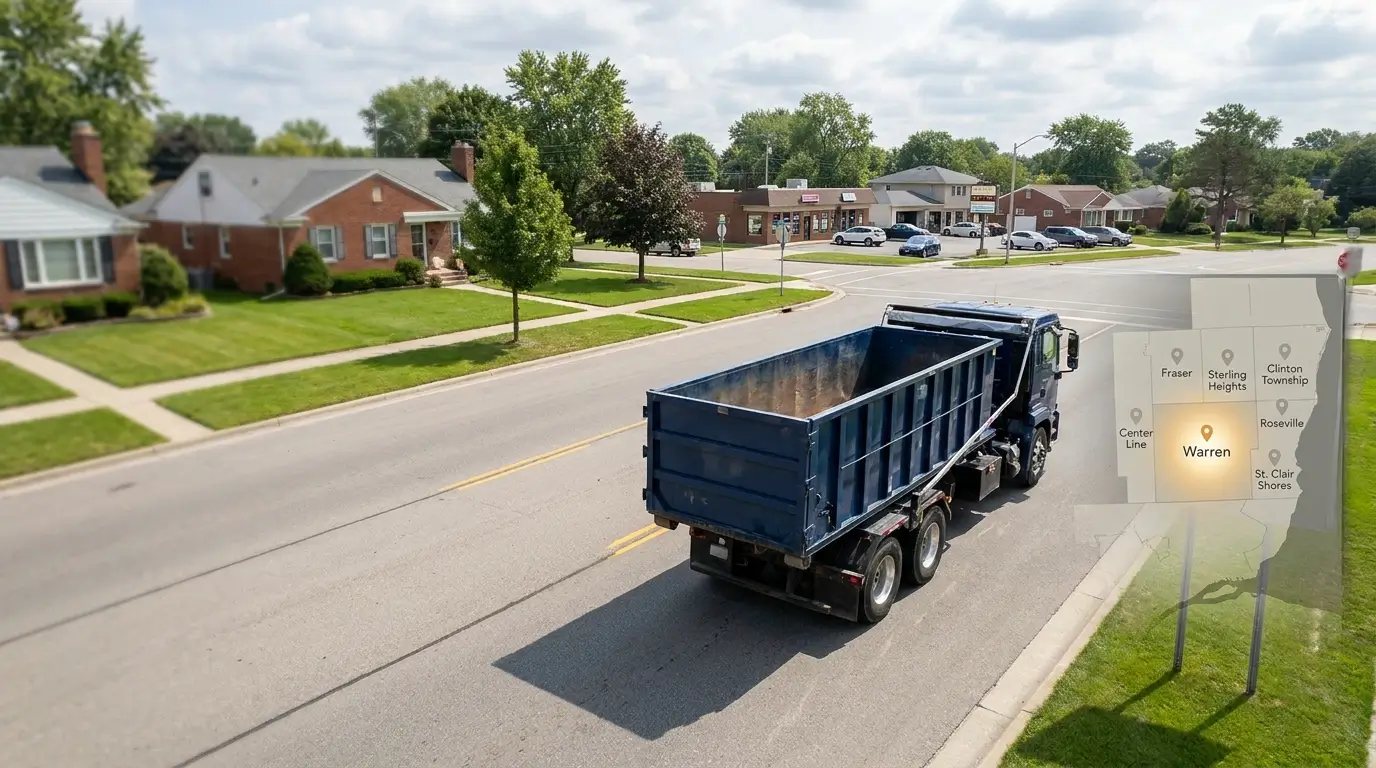
Warren Dumpster Rental helps connect customers with independent dumpster rental providers serving Warren and nearby communities where coverage is available. The matched provider handles the actual container availability, rental terms, pricing, billing, delivery, and pickup.
When discussing a roofing project, provide the estimated roof squares, shingle type, number of layers, and expected additional debris. This information helps the provider evaluate the appropriate container and weight allowance.
Questions to Ask Before Renting a Roofing Dumpster
Before confirming a rental, use the following checklist:
- What dumpster sizes are available for roofing debris?
- What is the included weight allowance?
- Are asphalt shingles accepted?
- Are multiple shingle layers permitted?
- Can roof decking, plywood, and underlayment go in the same container?
- What is the overweight charge?
- Is there a maximum load weight?
- Can the container be exchanged during the project?
- How many rental days are included?
- What is the additional daily rental charge?
- Can the dumpster be placed in my driveway?
- Are there restrictions on street or public right-of-way placement?
- How much notice is required for pickup?
Getting clear answers to these questions can help prevent confusion once the roofing work begins.
Frequently Asked Questions
What size dumpster do I need for a roof replacement?
The appropriate size depends on the roof’s square footage, shingle type, number of layers, additional materials, and the provider’s weight allowance. A 10-yard container may work for a smaller roof, while 15-yard or 20-yard options may suit some residential projects. Larger projects may require a 30-yard container or planned exchanges. Confirm the estimated weight before choosing.
How much do asphalt shingles weigh per square?
Asphalt shingles commonly weigh approximately 200–300 pounds per square, depending on the product. Heavy designer shingles can weigh more. One roofing square represents 100 square feet of roof surface.
How many tons of shingles come off a 20-square roof?
A 20-square roof with shingles weighing 200–300 pounds per square could produce approximately 4,000–6,000 pounds of shingle debris. That equals roughly 2–3 tons before underlayment, nails, flashing, and other materials are included.
Can I use a 10-yard dumpster for shingles?
Yes, a 10-yard dumpster may be appropriate for a smaller roofing project. However, the included weight allowance must be sufficient for the shingles and other materials. A container can reach its weight limit before it is physically full.
Is a 20-yard dumpster big enough for a roof replacement?
It may be suitable for many residential roofing projects, but it is not a universal solution. A large roof, multiple shingle layers, or substantial decking replacement may require a different arrangement. Check both the container volume and its weight allowance.
Are architectural shingles heavier than three-tab shingles?
Generally, yes. Architectural shingles have a thicker laminated construction and often weigh more per square than standard three-tab shingles. Exact weights depend on the manufacturer and product.
What happens if my roofing dumpster is overweight?
The provider may apply additional weight charges, require material removal, or arrange another disposal solution. The exact procedure depends on the rental agreement and transportation requirements. Ask about maximum load limits before loading begins.
Can I put roof decking and shingles in the same dumpster?
Some providers allow shingles and roof decking in the same container, but policies differ. Confirm that both materials are accepted and include the additional decking weight when estimating the load.
Can I mix household junk with roofing shingles?
Do not assume mixed materials are permitted. Some providers have restrictions on combining roofing debris with household waste, construction debris, or other materials. Ask before loading anything unrelated to the roofing project.
Should I rent a larger dumpster to avoid weight problems?
Not necessarily. A larger container provides more volume, but it does not automatically provide unlimited weight capacity. For dense shingles, the provider may recommend a smaller container, a different weight allowance, or scheduled exchanges.
How do I estimate roofing debris before renting?
Start with the roof area in squares. Multiply the number of squares by the estimated weight per square for the shingle product. Multiply again for multiple layers, then account for underlayment, flashing, and any roof decking or other materials being removed.
Can a dumpster be placed on the street in Warren, MI?
Do not assume that street placement is permitted. Public right-of-way and private-property placement can have different requirements. Confirm the exact location with the City of Warren and the rental provider before delivery.
How long should I keep a roofing dumpster?
The rental period depends on the provider and project schedule. A straightforward tear-off may take only a few days, while weather delays or additional repairs can extend the project. Confirm the included rental period and additional-day charges before booking.
Final Thoughts: Match the Dumpster to the Weight of the Roof
Choosing a dumpster for a roofing project requires more than estimating how much space the old shingles will occupy. The total weight of the material is often the more important consideration.
Start by determining the roof’s actual square footage, identifying the shingle type, and confirming how many layers will be removed. Then estimate the shingle weight and include underlayment, flashing, damaged decking, and other materials.
Compare that estimate with the container’s included weight allowance, not just its cubic-yard capacity. A 10-yard, 15-yard, or 20-yard dumpster may be a better choice for a particular roofing job than a larger container, depending on the material and the provider’s limits.
For roofing projects in Warren, MI, planning these details before delivery can help keep the work area organized, reduce the risk of overweight charges, and prevent unnecessary interruptions.
Warren Dumpster Rental helps customers connect with independent providers serving Warren and nearby communities where coverage is available. Share the roof size, shingle type, number of layers, and expected debris with the matched provider to discuss an appropriate container and rental arrangement.