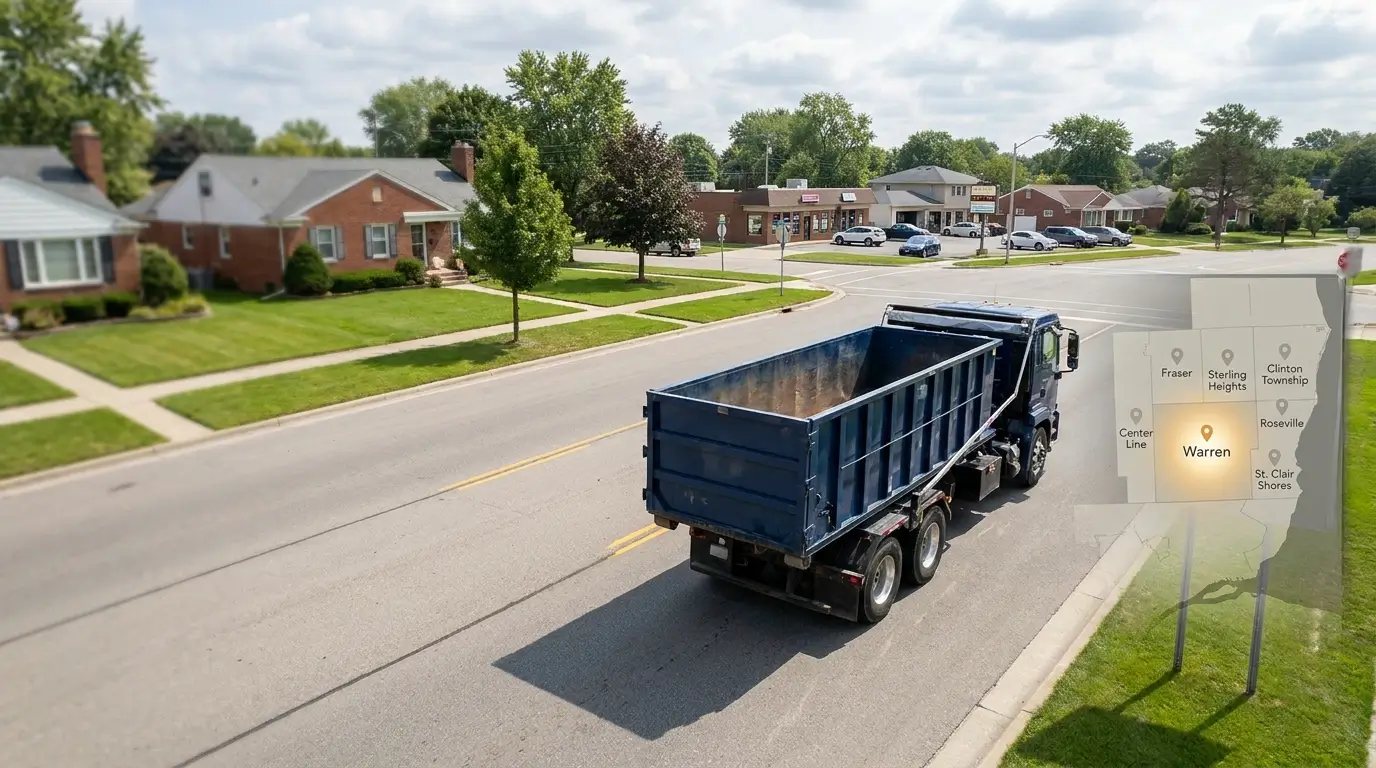
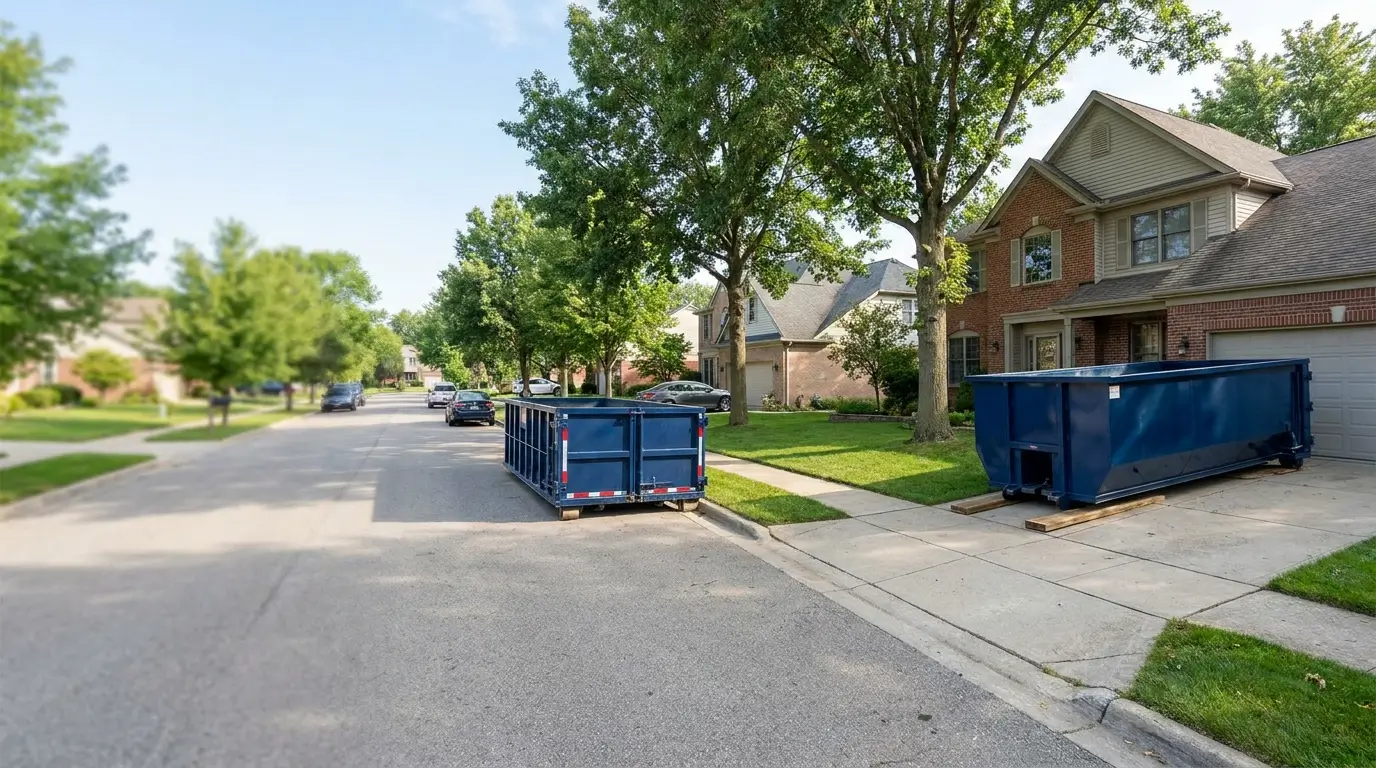
Cleaning up a yard can create more waste than many homeowners expect. Trimming shrubs, removing branches, clearing garden beds, replacing landscaping, and collecting fallen leaves can leave piles of organic debris around a property. If you are planning a major outdoor cleanup in Warren, Michigan, you may be wondering whether you can put all that yard waste into a roll-off dumpster.
The answer depends on the type of material, the dumpster provider’s rules, and whether you can use the City’s curbside compost collection program instead.
Leaves, grass clippings, small branches, and garden debris are handled through Warren’s municipal compost program under specific preparation requirements. Larger landscaping projects, however, may produce more material than a regular compost cart or paper bags can accommodate. A private dumpster may be another option, but you should never assume that every rental provider accepts every type of yard waste.
This guide explains how yard waste disposal works in Warren, MI, which materials may be suitable for a dumpster, what the City collects, and how to plan a landscaping cleanup without creating avoidable disposal problems.
Can You Put Yard Waste in a Dumpster?
Sometimes, yes. Some private dumpster providers accept certain types of yard waste, such as leaves, branches, grass clippings, and general landscaping debris. Others restrict organic waste or accept it only under specific conditions.
The important point is that acceptance depends on the rental provider and the type of material.
For example, a provider may accept ordinary leaves and small branches but restrict:
- Large tree trunks
- Tree stumps
- Root balls with large amounts of soil
- Wet or muddy soil
- Mixed loads containing rocks and concrete
- Treated or painted wood
- Diseased or potentially invasive plant material
A dumpster advertised for general household junk is not automatically suitable for a large landscaping cleanup.
Before booking, describe the material you plan to remove. Explain whether it consists of leaves, grass, brush, branches, shrubs, roots, soil, or a combination. Ask the provider to confirm which items are accepted and whether any limits apply.
If you only have a modest amount of leaves or grass clippings, Warren’s municipal compost collection may be more appropriate than renting a dumpster.
Understanding Warren’s Yard Waste and Compost Collection Program
The City of Warren operates a compost collection program for eligible residential yard waste.
According to the City’s published Sanitation Division guidelines, compost season generally runs from April 1 through December 1. During this period, qualifying yard waste is collected on residents’ scheduled collection days.
The City identifies common compost materials such as:
- Grass clippings
- Leaves
- Garden debris
- Flower-bed debris
- Small brush
- Eligible shrub trimmings
These materials must be prepared according to the City’s collection rules.
The program provides an alternative to placing ordinary yard waste in a private dumpster. For homeowners with routine seasonal cleanup, using the compost cart or approved paper bags may be simpler.
However, the municipal program has limits. Large branches, tree trunks, stumps, and other oversized materials are not handled like ordinary leaves and grass clippings.
What containers can you use?
Warren’s published guidelines specify two approved options for qualifying curbside compost:
- The City’s 95-gallon compost cart with a brown lid.
- Biodegradable brown paper bags with a capacity of up to 30 gallons.
Plastic bags are not accepted for the City’s curbside compost collection.
The compost cart must be able to close properly, and branches must not protrude from its top. Loose material should be placed according to the City’s instructions so it can be collected without spilling.
If you are preparing a large quantity of leaves or garden debris, do not use ordinary plastic trash bags and assume they will be collected as compost.
When can you place compost at the curb?
The City’s guidelines state that compost should be placed at the curb by 6:00 a.m. on the scheduled collection day, or no earlier than 6:00 p.m. on the evening before collection.
The City also instructs residents to place compost material approximately five feet away from other garbage at the curb.
Keep yard waste stored in the rear yard until the permitted placement time. Following the collection instructions helps prevent missed pickups and keeps the curbside area organized.
Is curbside compost collected all year?
No. The City’s published schedule generally runs from April 1 through December 1.
The published guidelines state that there is no regular curbside compost pickup from December 2 through March 31. Compost material is accepted at the Warren Recycling Center year-round, subject to the center’s eligibility and acceptance rules.
The City has occasionally announced seasonal extensions to compost pickup. Check the current Sanitation Division information for any changes before relying on a particular end date.
What Types of Yard Waste Can You Put in a Dumpster?
Private dumpster providers may accept several types of landscaping debris. The following sections explain common materials and the questions to ask before loading them.
Leaves
Leaves are one of the most common types of yard waste generated during fall cleanup.
A few bags of leaves usually do not require a dumpster. Warren residents can use the municipal compost program when it is operating and when the leaves are prepared according to the City’s rules.
A dumpster may become useful when leaves are part of a much larger property cleanup involving brush, branches, old landscaping materials, or other approved debris.
Before placing leaves in a container, ask whether the provider accepts loose leaves and whether there are restrictions on mixing them with general waste.
Leaves can take up considerable space when they are loose. If you are collecting a large volume, ask whether the provider has a separate yard-waste container or another recommended disposal arrangement.
Grass clippings
Grass clippings are another common compostable material.
For routine lawn maintenance, Warren’s compost cart or approved biodegradable paper bags are generally more appropriate than a roll-off dumpster.
Large landscaping projects may generate more clippings than the regular collection containers can accommodate. In that situation, ask a composting facility or waste provider about its accepted materials.
Do not assume that grass clippings can be mixed with every type of dumpster waste. Some providers restrict organic material because of disposal or processing requirements.
Small branches and brush
Small branches and brush may be accepted by some private dumpster providers, but size and quantity restrictions can apply.
Warren’s curbside guidelines require eligible branches and shrubs to be tied securely in small bundles.
The City’s published requirements specify that branches must be:
- Four feet or less in length
- Under two inches in diameter
- Light enough for one person to pick up as a bundle
These rules apply to the City’s curbside compost collection. A private dumpster provider may have different loading requirements, so do not assume the municipal dimensions automatically apply to a rental container.
For larger brush piles, ask whether the provider accepts branches and whether they need to be cut into smaller pieces.
Shrubs and hedge trimmings
Trimming hedges and removing shrubs can produce a mixture of branches, leaves, stems, and roots.
The above-ground portions may qualify for compost collection if they meet the City’s preparation rules. Private providers may also accept shrub trimmings as yard waste.
However, roots need separate attention. Warren’s curbside guidelines instruct residents to remove dirt from shrub roots and place the roots with garbage, while the cut and bundled shrub material goes with compost.
If you are using a dumpster, ask whether the provider accepts roots and root balls. Soil attached to roots can add substantial weight and may be restricted.
Garden and flower-bed debris
Removing old flowers, weeds, garden plants, and seasonal vegetation can create a significant amount of organic waste.
These materials are included among the types of yard waste identified in Warren’s compost guidelines.
For routine garden maintenance, use the municipal program when eligible. For a larger landscaping renovation, ask a private provider whether garden debris can be included with the other approved materials.
Keep rocks, bricks, concrete edging, plastic landscape fabric, and other non-organic materials separate unless the provider specifically approves a mixed load.
Tree branches and limbs
Large branches require more planning than ordinary brush.
The City of Warren’s curbside guidelines allow only small branches that meet its length, diameter, and bundle-weight requirements. Larger tree limbs are not suitable for ordinary curbside compost collection.
A private dumpster provider may accept larger branches, but maximum dimensions and loading rules vary.
Before ordering, estimate the length and number of branches. Also ask whether the provider accepts tree limbs mixed with leaves and other yard debris.
Tree trunks and stumps
Tree trunks and stumps are not ordinary curbside compost materials in Warren.
The City’s published guidance states that tree trunks and stumps are not collected curbside. It directs residents to cut eligible trunk and stump material to firewood-sized pieces and bring it to the Recycling Center for the City’s stated firewood-recycling process.
The published dimensions are 18 inches in length and under 10 inches in diameter.
Do not assume a private dumpster provider accepts large stumps or root balls. These materials can be extremely heavy, particularly when soil remains attached.
For a tree removal project, ask the tree service or disposal provider how trunks, stumps, roots, and branches will be handled.
What Yard Waste Should Not Go in a Dumpster Without Approval?
Even when a provider accepts general landscaping debris, certain materials may require separate disposal arrangements.
Dirt and soil
Dirt is not the same as ordinary compostable yard waste.
Excavated soil can be very heavy, especially when wet or compacted. Some dumpster providers restrict soil to specific containers or do not accept it in regular roll-off rentals.
If a landscaping project involves removing raised beds, grading a lawn, or excavating around a property, ask about soil acceptance separately.
For more detail, read our guide: Concrete, Brick and Dirt: How to Dispose of Heavy Debris.
Sod
Sod contains grass, roots, and soil. Although it comes from a landscaping project, it can be much heavier than loose grass clippings.
The City of Warren lists sod among the materials it does not collect through regular curbside refuse service.
Private dumpster providers may also restrict sod or require a dedicated arrangement because of its weight and soil content.
Do not mix large quantities of sod into a general yard-waste load without confirmation.
Rocks and landscaping stones
Decorative stones, gravel, and large rocks are heavy materials rather than ordinary compost.
A small number of stones may be manageable through an approved disposal route, but a large landscaping removal project can produce several tons of material.
Ask the provider whether rocks are accepted and whether a separate heavy-debris container is required.
Concrete edging and pavers
Concrete edging, patio blocks, retaining-wall blocks, and brick pavers should not be treated as yard waste.
These materials are heavy and may require a dedicated container or a recycling facility.
Keep them separate from leaves, brush, and other organic debris.
Treated or painted wood
Landscaping projects sometimes involve old fencing, deck boards, railroad ties, or other wood products.
Treated, painted, stained, or contaminated wood may have different disposal restrictions from untreated branches and natural brush.
Ask the provider whether these materials are accepted and whether they must be separated from organic yard waste.
Diseased or invasive plants
Some plant materials may require special handling, depending on the disease, pest, or invasive species involved.
Michigan’s environmental guidance recommends composting ordinary yard clippings or using appropriate composting facilities, but identifies diseased, infested, or invasive-species-control waste as a special case that may require different disposal.
Do not assume that diseased or invasive plant material belongs in a normal compost load. Follow applicable local and state guidance.
Dumpster Rental vs. Warren’s Compost Collection
For many homeowners, the choice is between using the City’s compost program and arranging a private dumpster.
Neither option is automatically better for every project. The right choice depends on the quantity, type, and timing of the cleanup.
| Project or material | Municipal compost collection | Private dumpster |
|---|---|---|
| Routine leaves | Usually suitable when prepared correctly | May be unnecessary |
| Grass clippings | Usually suitable when prepared correctly | Provider approval needed |
| Small brush | Suitable within City limits | Provider approval needed |
| Large branches | Not suitable for ordinary curbside compost | Ask about size and quantity limits |
| Tree stumps | Not collected curbside | Special approval or separate disposal |
| Large landscaping cleanup | May exceed regular collection capacity | May be practical if materials are accepted |
| Sod and soil | Not regular curbside compost | Weight restrictions likely |
| Concrete and pavers | Not compost material | Heavy-debris arrangements required |
When municipal compost collection makes sense
The City’s compost program is generally a practical choice for:
- Weekly lawn maintenance
- Routine leaf collection
- Small garden cleanups
- Hedge trimming
- Small quantities of eligible brush
- Seasonal flower-bed cleanup
If the material fits the approved containers and meets the City’s preparation rules, a private dumpster may not be necessary.
When a private dumpster may be more practical
A dumpster may be worth considering when:
- You are removing large landscaping beds.
- A property has accumulated a substantial amount of brush.
- You are clearing several garden areas at once.
- You are combining yard cleanup with a renovation project.
- You are removing approved landscaping materials over several days.
- You need one collection point for a large volume of accepted debris.
A provider may offer a container that accommodates the project, but confirm the accepted material list and weight restrictions before booking.
How to Choose a Dumpster for a Landscaping Project
If a private dumpster is the right option, choosing the correct size is the next step.
Unlike concrete or brick, many types of yard waste are relatively lightweight. However, branches, shrubs, roots, soil, and mixed landscaping debris can make the load heavier or bulkier than expected.
10-yard dumpster for small landscaping cleanups
A 10-yard container may be suitable for smaller projects involving approved yard waste.
Possible uses include:
- Clearing a small garden bed
- Removing hedge trimmings
- Cleaning up a limited amount of brush
- Removing old landscaping debris
- Combining a small yard cleanup with approved household waste
The container’s suitability depends on the provider’s material rules and weight allowance.
15-yard dumpster for moderate yard projects
A 15-yard container may provide additional room for moderate landscaping work.
It may be worth discussing when you are removing several garden beds, clearing brush, or completing a larger seasonal cleanup.
However, availability and yard-waste acceptance vary between providers.
20-yard dumpster for larger landscaping projects
A 20-yard container may be considered for larger projects that produce a significant volume of accepted debris.
Examples include:
- Extensive garden-bed removal
- Large shrub and hedge cleanup
- Multi-area landscaping renovation
- Combined yard and home renovation cleanup
If the project includes soil, sod, rocks, or concrete, discuss those materials separately before choosing a 20-yard container.
30-yard and 40-yard dumpsters
Larger containers may be useful for extensive property cleanups or mixed renovation projects.
However, a larger dumpster is not necessarily the best choice for dense landscaping materials.
Wet soil, large root balls, stones, and concrete can reach a weight limit before a large container is full. Some providers also prohibit certain materials regardless of the container size.
Always compare the material list, permitted load weight, and container volume.
How to Prepare Yard Waste Before Loading a Dumpster
If your provider confirms that the materials are accepted, preparing them properly can make loading easier.
1. Separate organic material from other debris
Keep leaves, grass, brush, and shrubs separate from soil, rocks, concrete, and household waste whenever practical.
This makes it easier to follow the provider’s disposal requirements.
2. Cut branches to manageable lengths
Long branches can create loading problems and leave unused space in a container.
Ask the provider about maximum branch length and diameter. Cut branches according to the provider’s instructions.
3. Remove excess soil from roots
Root balls can contain a surprising amount of dirt.
Remove loose soil when practical, but do not assume the remaining roots are accepted. Confirm the provider’s rules before loading them.
4. Avoid mixing wet and dry material unnecessarily
Wet leaves and grass can become heavy and compacted.
If you are preparing debris in advance, avoid allowing large piles to become soaked by rain where practical.
5. Keep the load below the container’s fill line
Do not stack branches or other materials above the container walls.
The load must remain within the provider’s loading and transportation requirements.
6. Keep prohibited materials out
Do not add chemicals, batteries, paint, pesticides, fuel, or other restricted materials unless the provider has confirmed an approved disposal arrangement.
7. Follow the provider’s loading instructions
Some providers have rules about mixing yard waste with construction debris or household junk.
Follow those instructions rather than assuming everything can be combined.
How to Reduce Yard Waste Disposal Costs
A little planning can reduce the amount of material you need to dispose of and help avoid unnecessary rental charges.
Mulch leaves and grass clippings
The City of Warren encourages residents to mulch grass and leaves when practical.
Mulching can return organic material to the lawn and reduce the amount that needs to be collected or transported.
For routine lawn care, this may be simpler than bagging everything.
Compost suitable garden material
Leaves, grass clippings, and suitable garden debris may be composted at home when managed properly.
Home composting can reduce the volume of material generated by routine yard maintenance.
Avoid placing diseased or unsuitable material into a home compost pile without checking appropriate guidance.
Reuse suitable branches and wood
Clean branches may sometimes be used for approved landscaping projects, natural edging, or other appropriate purposes.
Larger wood pieces may have separate reuse or recycling options.
Do not leave piles where they can create a nuisance or obstruct access.
Separate heavy materials
Keep concrete, bricks, stones, and soil separate from ordinary yard waste.
Mixing dense materials with light organic debris can make disposal more difficult and may increase costs.
Estimate the volume before ordering
Look at the size of the debris pile and estimate how much space it will occupy after branches are cut and material is loaded.
Share that estimate with the provider. Choosing an appropriate container can help avoid ordering too much or too little capacity.
Ask about weight limits and extra fees
Even if yard waste is accepted, the provider may have weight allowances or restrictions.
Ask about the included weight, additional charges, rental period, and any special handling requirements before confirming the rental.
Warren Recycling Center: What Residents Should Know
The City of Warren identifies its Recycling Center at 25801 Flanders Avenue as a location that accepts compost material year-round.
However, the center is not a general-purpose landfill, and its eligibility rules matter.
The City’s published information states that:
- The facility is intended for bona fide Warren residents.
- Residents must provide proof of residency.
- Contractors are not eligible to use the municipal sanitation facility for material disposal.
- Materials are subject to the center’s acceptance rules.
- Tree stumps and certain other materials are not accepted.
- Questionable materials may be judged by yard personnel.
The published hours are Monday through Friday, 7:30 a.m. to 4:00 p.m., and Saturday, 8:00 a.m. to noon. Saturday hours may change, so verify the current schedule before visiting.
The City lists the Sanitation Division phone number as (586) 775-1400.
If you have a large quantity of brush, branches, or landscaping debris, call first. Do not assume the center will accept every type of yard waste simply because it accepts compost.
Planning a Yard Cleanup in Warren, MI
The best disposal arrangement depends on the size and nature of the project.
A small seasonal cleanup may only require the City’s compost cart and approved paper bags. A major landscaping renovation may involve branches, shrubs, roots, soil, sod, rocks, and construction debris that need different disposal methods.
Before starting, make a list of everything being removed.
For example:
A basic fall cleanup may include:
- Leaves
- Grass clippings
- Garden debris
- Small shrub trimmings
These materials may be suitable for the City’s compost program when prepared correctly.
A larger landscaping renovation may include:
- Removed shrubs
- Large branches
- Root balls
- Sod
- Excavated soil
- Decorative stone
- Concrete edging
These materials need to be evaluated separately because they may not share the same disposal route.
Warren Dumpster Rental helps connect customers with independent dumpster rental providers serving Warren and nearby communities where coverage is available. The matched provider handles container availability, rental terms, pricing, billing, delivery, and pickup.
When discussing your project, explain the amount and type of yard waste you expect to generate. Mention any soil, sod, stumps, rocks, or concrete so the provider can confirm whether the materials are accepted and whether a dedicated arrangement is needed.
Questions to Ask Before Renting a Yard Waste Dumpster
Before scheduling delivery, ask the provider:
- Do you accept leaves and grass clippings?
- Are branches and brush allowed?
- Is there a maximum branch length or diameter?
- Can shrubs and hedge trimmings go in the same container?
- Are roots and root balls accepted?
- Can soil, sod, or rocks be included?
- Are tree stumps or logs prohibited?
- Can yard waste be mixed with household or construction debris?
- Is there a separate container for organic waste?
- What weight allowance is included?
- What are the additional weight charges?
- How many rental days are included?
- Can the container be exchanged if the project produces more debris?
Getting these answers before delivery can prevent confusion and reduce the risk of rejected material or unexpected fees.
Frequently Asked Questions
Can you put yard waste in a dumpster in Warren, MI?
Some private dumpster providers accept yard waste, including leaves, branches, and landscaping debris. Acceptance depends on the provider and material type. Warren also operates a municipal compost collection program for eligible yard waste prepared according to its guidelines.
Does Warren, Michigan collect leaves?
Yes. Leaves are included in the City’s compost collection program. During the published compost season, residents can place qualifying leaves in the City’s 95-gallon compost cart with a brown lid or in biodegradable brown paper bags up to 30 gallons. Plastic bags are not accepted for curbside compost.
When does Warren collect yard waste?
The City’s published compost season generally runs from April 1 through December 1. There is normally no curbside compost pickup from December 2 through March 31. The City may announce seasonal extensions, so check its current Sanitation Division information.
Can I put grass clippings in a dumpster?
Some private providers may accept grass clippings, but others restrict organic waste. For ordinary lawn maintenance in Warren, the municipal compost program is generally a suitable option when the material is prepared according to the City’s rules.
Can I put branches in a dumpster?
Some providers accept branches and brush, but they may have size and quantity restrictions. Ask about maximum branch length, diameter, and whether branches can be mixed with other yard waste.
Does Warren collect large tree branches?
Warren’s curbside compost guidelines allow only small branches that meet the City’s preparation requirements: four feet or less in length, under two inches in diameter, and bundled lightly enough for one person to lift. Larger branches are not suitable for ordinary curbside compost collection.
Can I put tree stumps in a dumpster?
Do not assume tree stumps are accepted. They are heavy and may require a special disposal arrangement. Warren’s published curbside guidelines do not allow tree trunks and stumps for regular curbside collection. Contact the City or a private provider for approved options.
Can I put dirt and sod in a yard waste dumpster?
Some providers may restrict dirt and sod because they are heavy. The City of Warren also lists dirt and sod among materials it does not collect through regular curbside refuse service. Confirm acceptance and weight requirements before renting.
Can I mix leaves, branches, and grass in one dumpster?
Some providers allow mixed yard waste, while others require specific materials to be separated. Ask before loading. Also keep soil, concrete, rocks, and other heavy materials separate unless explicitly approved.
Does the Warren Recycling Center accept yard waste?
The City identifies the Recycling Center as a year-round location for compost material, subject to its rules. It is intended for eligible Warren residents with proof of residency, and contractors are not eligible to use the municipal sanitation facility for disposal. Call before visiting with large or unusual materials.
Can contractors use Warren’s Recycling Center?
The City’s published Sanitation Division information states that contractors are not eligible to use the municipal sanitation facility for material disposal. Contractors should arrange an appropriate private disposal or recycling option.
Is a dumpster better than curbside compost collection?
It depends on the project. Curbside compost collection is generally practical for routine leaves, grass clippings, garden debris, and eligible small brush. A private dumpster may be more convenient for a large cleanup involving accepted landscaping debris or a combination of approved project materials.
What happens if a dumpster contains prohibited yard waste?
The provider may refuse pickup, require material removal, or apply additional charges depending on the rental agreement. Confirm accepted materials before loading the container.
Final Thoughts: Choose the Right Yard Waste Disposal Method
You can sometimes use a private dumpster for yard waste in Warren, but the provider must confirm that the specific materials are accepted.
For routine leaves, grass clippings, garden debris, and eligible small brush, the City’s compost program is often the most straightforward option. Follow its container, paper-bag, branch-bundling, and seasonal collection requirements.
For larger landscaping projects, ask a private provider about leaves, brush, branches, shrubs, roots, and other materials individually. Treat soil, sod, rocks, concrete, and tree stumps as separate disposal questions because they may have different restrictions.
Before ordering a dumpster, estimate the quantity, separate different material types, and confirm the provider’s weight limits and loading instructions.
A little preparation can help keep your yard cleanup organized, avoid rejected loads, and make it easier to choose the right disposal arrangement for your Warren property.