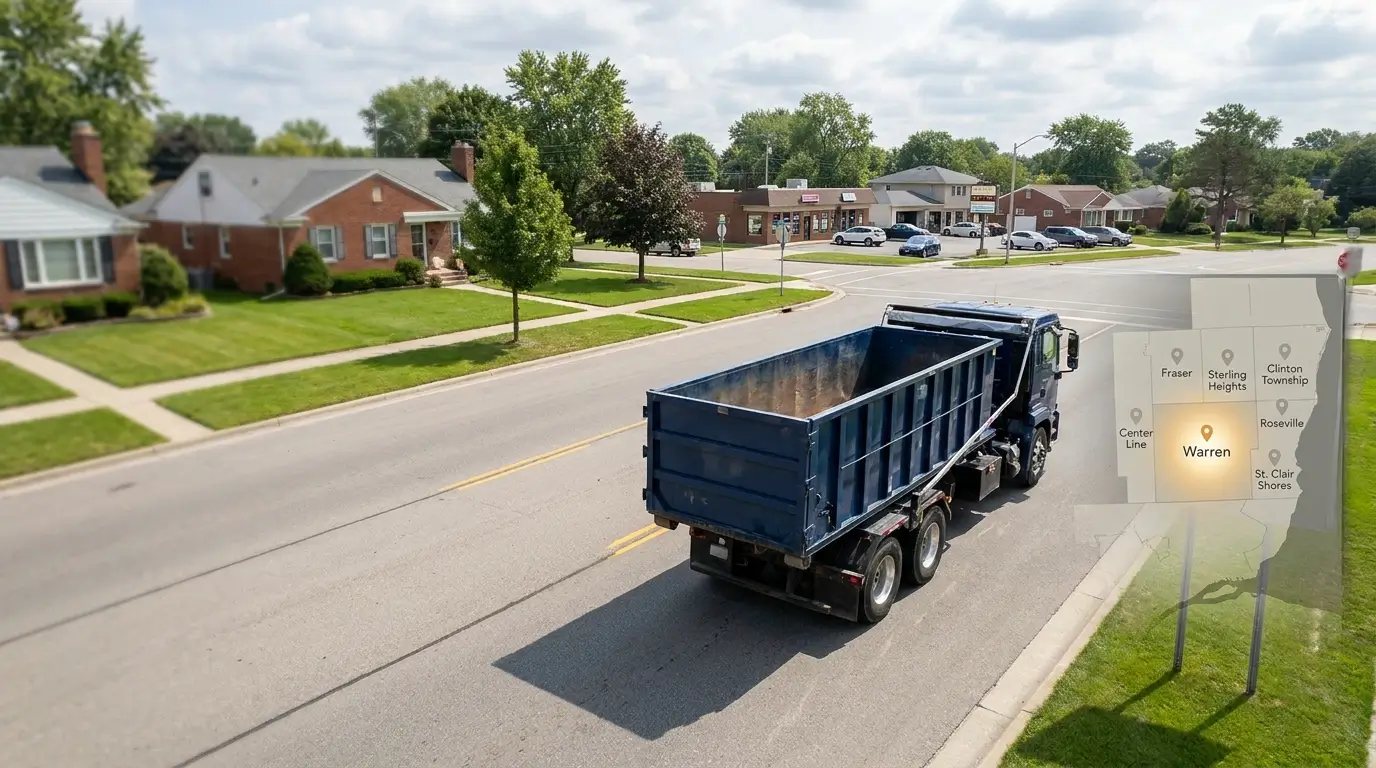
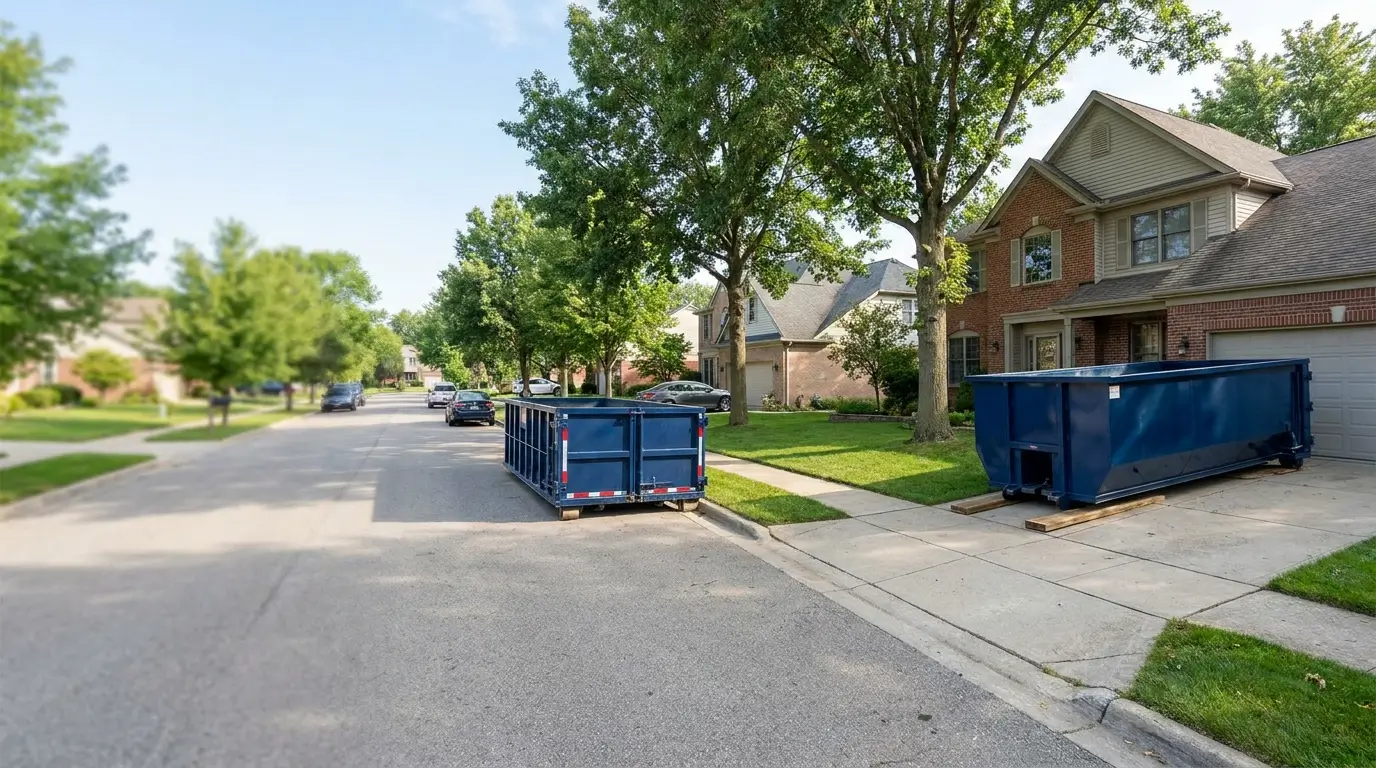
Concrete, brick, and dirt are among the heaviest materials produced during home improvement, landscaping, demolition, and construction projects. Whether you are removing an old patio, replacing a concrete driveway, tearing down a brick structure, or excavating soil for a landscaping project, disposing of these materials requires more planning than getting rid of ordinary household junk.
The biggest challenge is weight. A relatively small pile of concrete or dirt can weigh several tons. A dumpster that looks only partially full may already be close to its maximum permitted weight. If the container is overloaded, the rental provider may be unable to transport it safely, and additional disposal charges or removal arrangements may be necessary.
For homeowners, contractors, and property managers in Warren, Michigan, understanding the available disposal options can help prevent delays and unnecessary expenses.
This guide explains how to dispose of concrete, brick, dirt, and other heavy debris. You will learn how to estimate material weight, choose an appropriate dumpster, prepare debris for removal, and compare recycling, disposal, and rental options.
Why Concrete, Brick and Dirt Require Special Disposal Planning
Most general-purpose dumpster rentals are designed to handle a mixture of household junk, furniture, construction materials, and renovation debris. Heavy materials create a different challenge because their weight increases much faster than their volume might suggest.
Consider the difference between a dumpster filled with cardboard boxes and one containing broken concrete. Both containers may occupy the same amount of space, but the concrete load can weigh many times more.
Heavy debris needs special consideration for several reasons:
- High density: Concrete, brick, stone, and soil are substantially heavier than many common household materials.
- Weight restrictions: Dumpster providers establish maximum load limits and may restrict certain materials to specific container sizes.
- Transportation safety: An overloaded container can create unsafe hauling conditions.
- Disposal requirements: Concrete, masonry, and clean soil may have different recycling or disposal options from mixed construction waste.
- Contamination: Dirt mixed with roots, trash, chemicals, or other materials may not qualify for the same disposal route as clean soil.
- Additional charges: Exceeding an included weight allowance can result in overage fees.
The most important rule is to plan around both volume and weight. Do not assume that a dumpster is suitable for concrete, brick, or dirt simply because the material physically fits inside it.
What Counts as Heavy Debris?
Heavy debris includes materials that can quickly increase the weight of a roll-off container.
Common examples include:
- Broken concrete slabs
- Concrete driveway sections
- Sidewalk and patio pieces
- Concrete blocks
- Bricks and masonry
- Mortar and masonry rubble
- Stone and natural rock
- Gravel
- Excavated soil
- Clay
- Sand
- Sod
- Asphalt chunks
- Pavers and retaining-wall blocks
- Ceramic tile and other dense construction materials
Not every dumpster provider accepts all these materials. Some accept concrete and brick only in designated containers, while others have restrictions on soil, gravel, asphalt, or mixed loads.
Before loading anything, describe the exact material to the rental provider. Ask whether it is accepted, whether it must be separated, and what container and weight restrictions apply.
How Heavy Is Concrete?
Concrete is extremely dense compared with ordinary household waste. Its weight depends on the mixture, aggregate, moisture content, and condition of the material.
For preliminary planning, ordinary concrete is often estimated at approximately 2 tons per cubic yard. This is a rough estimating figure, not a guaranteed weight for every concrete load.
The estimate helps explain why concrete disposal requires careful planning.
For example:
| Concrete volume | Approximate weight |
|---|---|
| ¼ cubic yard | 0.5 ton |
| ½ cubic yard | 1 ton |
| 1 cubic yard | 2 tons |
| 1½ cubic yards | 3 tons |
| 2 cubic yards | 4 tons |
Even a small amount of concrete can use a substantial portion of a dumpster’s weight allowance.
Concrete driveway removal
Removing an old concrete driveway can create a large quantity of heavy debris.
The total depends on:
- Driveway length and width
- Concrete thickness
- Whether the driveway has multiple layers
- Reinforcement such as wire mesh or rebar
- Whether the material is broken into smaller pieces
- Whether the project includes a walkway or parking area
A driveway measuring 20 feet by 40 feet covers 800 square feet. If the concrete is approximately 4 inches thick, the original slab contains roughly 9.9 cubic yards of material before considering voids, irregular edges, or demolition conditions.
Using the approximate 2-ton-per-cubic-yard planning figure, that represents a very substantial load.
This example demonstrates why a full driveway demolition should not be treated like an ordinary household dumpster rental. Ask the contractor and disposal provider to estimate the actual material volume and weight before arranging a container.
Concrete patio removal
A concrete patio may produce less debris than a driveway, but its weight can still be significant.
Before choosing a dumpster, measure the patio’s approximate length, width, and thickness. Include attached walkways, steps, or other concrete features if they will also be removed.
If the patio contains decorative stone, pavers, or a separate gravel base, determine whether those materials will be removed and how they will be handled.
How Heavy Are Bricks and Masonry?
Brick and masonry debris can also become extremely heavy when collected in large quantities.
The actual weight depends on the type of brick, dimensions, density, mortar, moisture, and whether the debris includes concrete blocks or stone.
Common masonry debris includes:
- Clay bricks
- Concrete bricks
- Concrete masonry units
- Mortar
- Stone veneer
- Retaining-wall blocks
- Chimney bricks
- Broken masonry steps
- Brick patio pavers
A small pile of individual bricks may be manageable, but a demolished wall or chimney can produce a much heavier load than expected.
Brick wall demolition
The weight of a demolished brick wall depends on its height, length, thickness, and construction.
A wall may also contain mortar, insulation, wood framing, metal ties, or other materials.
Before placing the debris in a dumpster, ask whether the provider accepts mixed masonry and whether the load must contain only brick and concrete.
Separating masonry from wood, drywall, insulation, and household junk can make disposal arrangements easier.
Brick patio and walkway removal
Brick patios and walkways may contain more than visible bricks. Underneath the surface, there may be sand, gravel, compacted soil, or a concrete base.
Removing the entire installation can therefore create several types of debris.
Separate the materials when practical, and confirm whether the provider accepts the different components in the same container.
How Heavy Is Dirt and Soil?
Dirt can be particularly difficult to estimate because its weight changes depending on composition and moisture.
Dry topsoil, compacted clay, wet soil, and soil containing rocks do not weigh the same amount.
The following factors influence soil weight:
- Moisture content
- Sand, clay, and organic matter composition
- Compaction
- Rocks and gravel mixed into the soil
- Roots and vegetation
- Whether the material is loose or excavated in large chunks
Wet soil can be substantially heavier than dry soil. Rainwater and trapped moisture may increase the load after the material has been placed in a pile or container.
This is one reason to avoid filling a dumpster with soil based only on its visible volume.
Excavated soil from landscaping
Landscaping projects often create soil that needs to be removed from the property.
Examples include:
- Garden-bed excavation
- Lawn grading
- Removing raised planting areas
- Digging for retaining walls
- Preparing ground for a patio
- Removing soil around foundations
- Excavating for drainage improvements
Clean soil may have different disposal options from mixed construction debris. However, acceptance depends on the receiving facility and the condition of the material.
Soil mixed with roots, concrete fragments, trash, chemicals, or other contaminants may require a different disposal arrangement.
Clay and compacted soil
Clay-heavy soil can be dense and difficult to handle. It may also become much heavier when wet.
If your project involves clay excavation, tell the provider before ordering a container. Do not estimate the load using the same assumptions as loose, dry topsoil.
How to Estimate the Volume of Heavy Debris
Before choosing a disposal method, estimate how much material the project will generate.
A basic volume calculation uses three measurements:
Length × Width × Height = Cubic feet
Then divide the result by 27 to convert cubic feet into cubic yards.
Cubic yards = Length × Width × Height ÷ 27
For example, suppose a pile of broken concrete measures:
- 8 feet long
- 6 feet wide
- 2 feet high
The estimated volume is:
8 × 6 × 2 = 96 cubic feet
96 ÷ 27 = approximately 3.56 cubic yards.
This is a rough pile-volume calculation. Irregular debris, spaces between concrete pieces, and the way the material is stacked can affect the actual volume.
Measure the original material before demolition
For concrete slabs, patios, and walkways, measuring the original structure before breaking it apart can provide a more useful starting point.
Calculate the original slab volume using its length, width, and thickness.
For example:
- Length: 12 feet
- Width: 10 feet
- Thickness: 4 inches, or approximately 0.33 feet
12 × 10 × 0.33 = approximately 39.6 cubic feet.
39.6 ÷ 27 = approximately 1.47 cubic yards.
This estimates the volume of the original solid concrete. The broken material may occupy more space because of gaps between pieces.
For disposal planning, the weight estimate is often more important than the loose pile volume.
Can You Put Concrete, Brick and Dirt in a Regular Dumpster?
Sometimes, but not always.
A standard roll-off dumpster is not automatically approved for heavy materials. Providers may restrict concrete, brick, dirt, and masonry to specific container sizes or require a dedicated heavy-debris rental.
For example, some providers accept heavy materials only in a 10-yard container, while others may offer separate concrete or clean-fill arrangements. These are provider-specific policies, not universal industry rules.
Before renting, ask:
- Is concrete accepted?
- Are bricks and masonry accepted?
- Can dirt or soil be placed in the same container?
- Is there a maximum amount of heavy material?
- Is a dedicated container required?
- What is the maximum permitted load weight?
- Does the rental include a weight allowance?
- Are additional weight charges applicable?
- Can the container be exchanged if the project produces more debris?
Do not assume that a 20-, 30-, or 40-yard container is suitable simply because it has enough space.
A smaller container designed for heavy materials may be a more appropriate option.
Choosing the Right Dumpster for Concrete, Brick and Dirt
The right container depends on the material, project size, and rental provider’s restrictions.
10-Yard Dumpster for Heavy Debris
A 10-yard container may be an appropriate option for some smaller heavy-material projects, depending on its weight rating and the provider’s acceptance rules.
Potential applications include:
- Small concrete patio removal
- Limited sidewalk demolition
- A small quantity of bricks
- Minor landscaping excavation
- Small retaining-wall repairs
- Limited masonry cleanup
Some providers specifically restrict concrete, dirt, and brick to 10-yard containers.
However, a 10-yard dumpster is not automatically suitable for every concrete or soil project. A small container can still become overweight if too much dense material is loaded into it.
Confirm the maximum permitted weight before delivery.
15-Yard Dumpster for Moderate Projects
A 15-yard dumpster may be useful for projects that produce a moderate volume of debris, but its suitability for heavy materials depends entirely on provider policy.
Possible projects to discuss with a provider include:
- Larger patio removal
- Moderate brick cleanup
- Landscaping excavation
- Mixed construction debris with limited heavy material
Do not assume that a 15-yard container can accept a full load of concrete or dirt. Some providers may not allow these materials in this size at all.
20-Yard Dumpster for Mixed Construction Debris
A 20-yard container is commonly considered for general renovation and construction waste.
It may be useful when a project includes a mixture of bulky materials such as wood, drywall, cabinets, and other construction debris.
However, a 20-yard dumpster may not be approved for a full load of concrete, brick, or soil.
If heavy materials are part of the project, ask whether they need a separate container.
30-Yard and 40-Yard Dumpsters
Larger dumpsters provide more physical volume, but they are not necessarily better for dense debris.
A 30-yard or 40-yard container may be suitable for a large renovation project involving a mixture of lighter construction materials.
For a project consisting mostly of concrete, brick, or dirt, these larger containers may be inappropriate or restricted by the provider.
Do not order a larger container to solve a weight problem without confirming its permitted material and load limits.
Should You Separate Concrete, Brick and Dirt?
Separating heavy materials is often a practical way to improve disposal planning.
Concrete, brick, soil, and other masonry materials may have different recycling or disposal destinations. Mixing them with general construction waste can make it more difficult to identify an appropriate receiving facility.
Consider separating materials into these groups:
| Material group | Examples |
|---|---|
| Concrete | Slabs, sidewalks, driveways, concrete steps |
| Masonry | Bricks, blocks, mortar, stone |
| Clean soil | Excavated dirt without significant contamination |
| Landscaping debris | Sod, roots, branches, vegetation |
| General construction waste | Wood, drywall, trim, packaging |
A provider may accept some combinations but reject others.
For example, clean concrete may be suitable for a concrete recycling facility, while soil containing roots and household trash may need a different disposal route.
Always ask before mixing materials.
Can Concrete and Brick Be Recycled?
Yes. Concrete and some masonry materials can be processed for reuse rather than sent directly to a landfill.
Concrete recycling facilities may crush and process old concrete into aggregate for applications such as:
- Road base
- Construction fill
- Drainage applications
- Subbase material
- Other approved construction uses
Brick may also be reused, crushed, or processed depending on its condition and the receiving facility.
However, not every recycling location accepts every type of masonry.
Reinforcing steel, asphalt, soil, wood, and other contaminants may affect acceptance. Some facilities require loads to be separated or may charge different rates depending on the material.
If you have a substantial amount of clean concrete or brick, ask whether a dedicated recycling facility is a better option than a mixed-waste dumpster.
How to Dispose of Dirt and Soil Properly
Dirt disposal depends on the soil’s condition and the type of project that generated it.
Clean, uncontaminated soil may be accepted by certain facilities for approved fill, grading, or other uses. Other facilities may not accept soil at all.
Before transporting or arranging removal, consider the following:
Keep clean soil separate
Do not mix clean excavated soil with household garbage, chemicals, paint, treated wood, or other questionable materials.
Keeping it separate can help identify suitable disposal or reuse options.
Identify potentially contaminated soil
Soil from industrial properties, old fuel storage areas, chemical storage locations, or sites with a known contamination history may require testing and specialized handling.
Do not assume potentially contaminated soil can be placed in an ordinary dumpster.
Ask the relevant environmental authority or qualified waste professional about the correct handling requirements.
Avoid unnecessary water
If soil is being stockpiled before removal, protect it from unnecessary rainwater where practical.
Wet soil is heavier and can make loading more difficult.
Confirm acceptance before transport
Do not load a truck or rent a dumpster until the receiving facility or provider confirms that the material is acceptable.
Other Disposal Options for Heavy Debris
A roll-off dumpster is not the only way to handle concrete, brick, and dirt.
Depending on the project size and material condition, other options may be more practical.
Concrete recycling facilities
If you have clean broken concrete, a concrete recycling facility may be worth considering.
These facilities may accept concrete for crushing and processing, sometimes with separate requirements for reinforced concrete, mixed loads, and contamination.
Ask about:
- Accepted concrete types
- Whether rebar is allowed
- Whether asphalt or brick can be mixed with concrete
- Minimum or maximum load quantities
- Drop-off hours
- Tipping or processing charges
- Vehicle requirements
Masonry recycling or reuse
Intact bricks, pavers, and some blocks may be reusable.
If they are in good condition, consider whether they can be reused in another part of the property or offered to someone undertaking a similar project.
Broken masonry may be accepted by certain recycling or processing facilities.
Soil reuse
Clean soil may sometimes be reused on the same property for approved grading or landscaping work.
It may also be suitable for another project, depending on soil quality and local requirements.
Do not transfer potentially contaminated soil to another property without confirming applicable environmental rules.
Private disposal facilities
Private waste and recycling facilities may accept materials that are not collected through ordinary municipal curbside service.
Acceptance, fees, vehicle requirements, and operating hours vary. Call ahead and describe the exact material and quantity.
Roll-off dumpster rental
A roll-off container may be convenient when demolition or excavation creates a large amount of debris over several days.
The provider can explain whether a dedicated heavy-material container is available, what weight limit applies, and whether a separate container is required for different materials.
Heavy Debris Disposal Rules in Warren, MI
Homeowners in Warren should understand that ordinary city curbside collection is not a disposal option for concrete, dirt, bricks, rocks, and similar materials.
The City of Warren’s Sanitation Division specifically lists dirt, sod, mulch, bricks, rocks, tires, shingles, concrete, and hazardous waste among the materials that will not be collected curbside.
This means residents should not place these materials beside their regular garbage carts expecting normal pickup.
The city also identifies its Recycling Center at 25801 Flanders as a resident facility with specific eligibility and material restrictions. Its published information states that only bona fide Warren residents with proof of residency may use the facility, and contractors are not eligible to use the sanitation facility for material disposal. The center is not a licensed dump, and questionable materials are subject to staff judgment.
For heavy materials, the city’s Sanitation Division lists separate private disposal contacts, including:
- Concrete, rocks, dirt, clay, and sod: Unidig, 21600 Quinn Road, Clinton Township.
- Concrete: Clancy Clean Crush Cement, 29950 Little Mack, Roseville.
- Concrete: Joe Davis, 25501 Sherwood, Warren.
These listings are provided by the City of Warren, but acceptance, pricing, hours, and operating arrangements can change. Contact the facility before loading or transporting material.
The city also lists Metro Transfer Center and Pine Tree Acres Landfill as licensed disposal locations for other waste categories. Do not assume that either facility accepts every type of concrete, brick, or soil.
For current information, review the City of Warren’s Sanitation Division page and contact the facility directly before arranging disposal.
How to Prepare Heavy Debris for Dumpster Loading
Once the provider confirms that the materials are accepted, prepare the debris carefully.
1. Break large concrete into manageable pieces
Large concrete slabs can be difficult to handle and may create loading problems.
If the contractor is breaking concrete, discuss the size of the pieces before loading. Follow the provider’s instructions about maximum piece dimensions and loading methods.
2. Keep the material organized
Separate concrete, brick, soil, and other debris when required.
An organized loading area makes it easier to estimate quantities and reduces the risk of accidentally adding prohibited materials.
3. Do not overload one area
Follow the provider’s loading instructions and distribute material as directed.
Avoid creating a single concentrated pile that makes the load unstable or exceeds container restrictions.
4. Keep the load below the fill line
Heavy materials must remain within the container’s permitted loading height.
Never stack debris above the walls or leave pieces hanging over the sides.
5. Keep prohibited materials out
Do not add paint, chemicals, oil, batteries, propane cylinders, or other restricted materials unless the provider has specifically confirmed an approved disposal arrangement.
6. Keep water and contamination under control
Avoid placing standing water, muddy mixtures, or potentially contaminated soil in a container without prior approval.
The provider may have separate requirements for wet or mixed materials.
Common Mistakes When Disposing of Heavy Debris
Poor planning can make a relatively straightforward demolition or landscaping project more expensive.
Avoid these common mistakes:
Choosing a dumpster based only on cubic yards
A container’s volume does not tell you how much concrete, brick, or dirt it can safely carry.
Always ask about the maximum permitted weight and material restrictions.
Mixing all debris together
Concrete, soil, bricks, wood, and household junk may have different disposal requirements.
Separating materials can make it easier to find an appropriate recycling or disposal option.
Assuming every provider accepts dirt
Some providers accept clean fill, while others do not accept soil in their regular containers.
Ask specifically about dirt, clay, sod, and mixed soil.
Ignoring moisture
Wet soil can weigh considerably more than dry soil.
If you are estimating a large excavation project, account for the possibility that the material may be wet.
Filling a dumpster to the top
A container can become overweight before it is full.
Never use the container walls as a guide to determine whether the load is within the permitted weight.
Forgetting about additional materials
A concrete patio project may also generate sand, gravel, roots, pavers, and landscaping waste.
Include these materials in the disposal plan.
Failing to confirm local disposal rules
Municipal curbside programs and private facilities do not necessarily accept the same materials.
Check the current rules before moving heavy debris to a collection point.
How to Avoid Unexpected Heavy-Debris Disposal Costs
The best way to control disposal costs is to understand the rental terms before the project begins.
Use the following steps:
- Estimate the material quantity. Measure the area and thickness of the concrete, brickwork, or soil being removed.
- Identify every material. Explain whether the load contains concrete, brick, dirt, clay, sod, or a mixture.
- Ask about dedicated containers. Some providers require a specific size for heavy debris.
- Confirm the weight allowance. Find out the maximum permitted weight and what is included in the rental.
- Understand overage charges. Ask how additional weight is calculated and billed.
- Compare recycling options. A specialized concrete facility may be more suitable for a large clean concrete load.
- Ask about container exchanges. For larger projects, a planned exchange may be necessary.
- Confirm rental duration. Excavation and demolition schedules can change because of weather or unexpected site conditions.
- Get the agreement in writing. Keep the container size, accepted materials, weight allowance, and additional charges documented.
For more information about weight-related charges, read our guide, Dumpster Overage Fees: How Weight Limits Affect Your Final Bill.
Planning Heavy-Debris Disposal for Projects in Warren
Different home improvement projects create different types of heavy waste.
The best disposal arrangement depends on the material and how much of it the project will produce.
Driveway replacement
A driveway replacement can generate a large amount of concrete. Ask whether a concrete recycling facility can accept the material directly or whether a dedicated heavy-debris container is available.
Patio demolition
A patio project may involve concrete, brick pavers, sand, gravel, and soil.
Identify each material before ordering a container. Separating the concrete from the base material may provide more disposal options.
Landscaping and grading
Landscaping projects commonly produce excavated soil, clay, sod, rocks, and roots.
Ask whether clean soil is accepted and whether vegetation or mixed landscaping debris needs a separate container.
Retaining-wall removal
Removing a retaining wall can produce concrete blocks, natural stone, soil, and landscaping materials.
The weight can add up quickly, particularly when the wall includes a substantial foundation.
Basement or foundation work
Excavation and concrete removal around foundations may produce heavy, dense material.
Discuss the expected quantity with the contractor and confirm the disposal method before work starts.
Warren Dumpster Rental helps connect customers with independent dumpster rental providers serving Warren and nearby communities where coverage is available. The matched provider handles container availability, rental terms, pricing, billing, delivery, and pickup.
When requesting a rental arrangement, explain the type of heavy debris, estimated quantity, project location, and expected schedule. This helps the provider determine whether a dedicated heavy-material container or another disposal option is appropriate.
Heavy-Debris Disposal Checklist
Use this checklist before starting a concrete, brick, or dirt removal project:
- Identify all materials being removed.
- Estimate the total quantity.
- Measure concrete thickness where applicable.
- Determine whether the soil is clean or potentially contaminated.
- Separate concrete, masonry, soil, and general waste when practical.
- Check whether recycling is available.
- Confirm the provider accepts the exact material.
- Ask whether a dedicated heavy-debris container is required.
- Confirm the maximum permitted load weight.
- Understand the included weight allowance and overage charges.
- Prepare a safe location for the container.
- Confirm pickup or exchange arrangements.
- Verify local disposal requirements before transporting material.
Frequently Asked Questions
Can I put concrete in a regular dumpster?
Some dumpster providers accept concrete, but others restrict it to designated containers or specific sizes. Concrete is extremely heavy, so confirm the accepted material, container requirements, and maximum weight before loading.
What size dumpster do I need for concrete?
A 10-yard container may be appropriate for some small concrete projects, but the correct size depends on the quantity and the provider’s weight restrictions. Some providers require concrete to be placed in a dedicated container. Do not choose based on volume alone.
How much does one cubic yard of concrete weigh?
A common preliminary planning estimate for ordinary concrete is approximately 2 tons per cubic yard. Actual weight varies with the concrete mixture, aggregate, moisture, and other conditions.
Can I put bricks and concrete in the same dumpster?
Some providers allow a combined masonry load, while others require materials to be separated. Ask whether bricks, concrete blocks, mortar, and broken concrete can be combined before loading.
Can dirt go in a roll-off dumpster?
Some providers accept clean soil, while others restrict dirt or require a dedicated container. Wet or contaminated soil may have additional restrictions. Confirm acceptance before ordering.
Can I put wet dirt in a dumpster?
Do not assume wet soil is accepted. Moisture increases weight, and some providers have strict restrictions on soil loads. Ask about the maximum permitted weight and whether wet material is allowed.
Can concrete be recycled instead of thrown away?
Yes. Clean concrete may be accepted at recycling facilities, where it can be crushed and processed into aggregate for approved construction uses. Acceptance rules vary, particularly for concrete containing rebar, asphalt, soil, or other materials.
Does Warren, MI collect bricks or concrete at the curb?
No. The City of Warren’s published curbside guidance lists bricks, concrete, rocks, and dirt among the materials it will not collect through regular curbside service. Residents should arrange an approved alternative.
Can Warren contractors use the city’s Recycling Center?
The city’s published Sanitation Division information states that contractors are not eligible to use the municipal sanitation facility for material disposal. The center is intended for qualifying Warren residents with proof of residency, and its material acceptance is limited.
Where can I take concrete in Warren?
The City of Warren lists private concrete disposal or recycling contacts, including Joe Davis at 25501 Sherwood in Warren and Clancy Clean Crush Cement in Roseville. Contact the facility before visiting to verify current acceptance, hours, fees, and vehicle requirements.
Can I mix dirt, sod, and rocks together?
Do not assume they can be combined. A provider or disposal facility may have different rules for clean soil, sod, rocks, roots, and mixed landscaping debris. Ask before loading.
What happens if my dumpster is overweight?
The provider may charge additional weight fees, require an alternative disposal arrangement, or decline to transport an overloaded container. The exact procedure depends on the rental agreement and applicable transportation requirements.
Is a bigger dumpster better for heavy debris?
Not necessarily. A larger container provides more space, but it does not automatically provide more permitted weight. A smaller, appropriately rated container may be more suitable for dense concrete, brick, or dirt.
Should I rent a dumpster or use a concrete recycling facility?
For a large quantity of clean concrete, a specialized recycling facility may be worth considering. A dumpster may be more convenient when the project includes several types of debris or when material needs to be collected over multiple days. Compare acceptance requirements, transport arrangements, and total costs.
Final Thoughts: Plan Heavy-Debris Disposal Before Demolition Begins
Concrete, brick, and dirt require a different disposal strategy from ordinary household or renovation waste. Their high density means that even a relatively small quantity can create a heavy load.
Start by identifying the materials, estimating their volume, and considering how much they may weigh. Separate clean concrete, masonry, and soil when practical, and compare recycling facilities with dedicated heavy-debris dumpster options.
For projects in Warren, MI, remember that the city’s regular curbside collection does not accept concrete, bricks, rocks, or dirt. Residents and contractors should confirm an appropriate private disposal or recycling arrangement before starting work.
Most importantly, never assume that a dumpster can accept heavy debris simply because the material fits inside. Confirm the provider’s restrictions, weight allowance, and loading instructions before delivery.
With the right planning, you can keep your project organized, avoid preventable weight charges, and choose a disposal method that suits the material being removed.