Cubic yards can be difficult to visualize when you are planning a home renovation, garage cleanout, roofing project, or construction job. Most people do not regularly measure waste in cubic yards, but they understand what fits in the bed of a pickup truck.
That makes pickup-truck loads a useful way to estimate dumpster capacity.
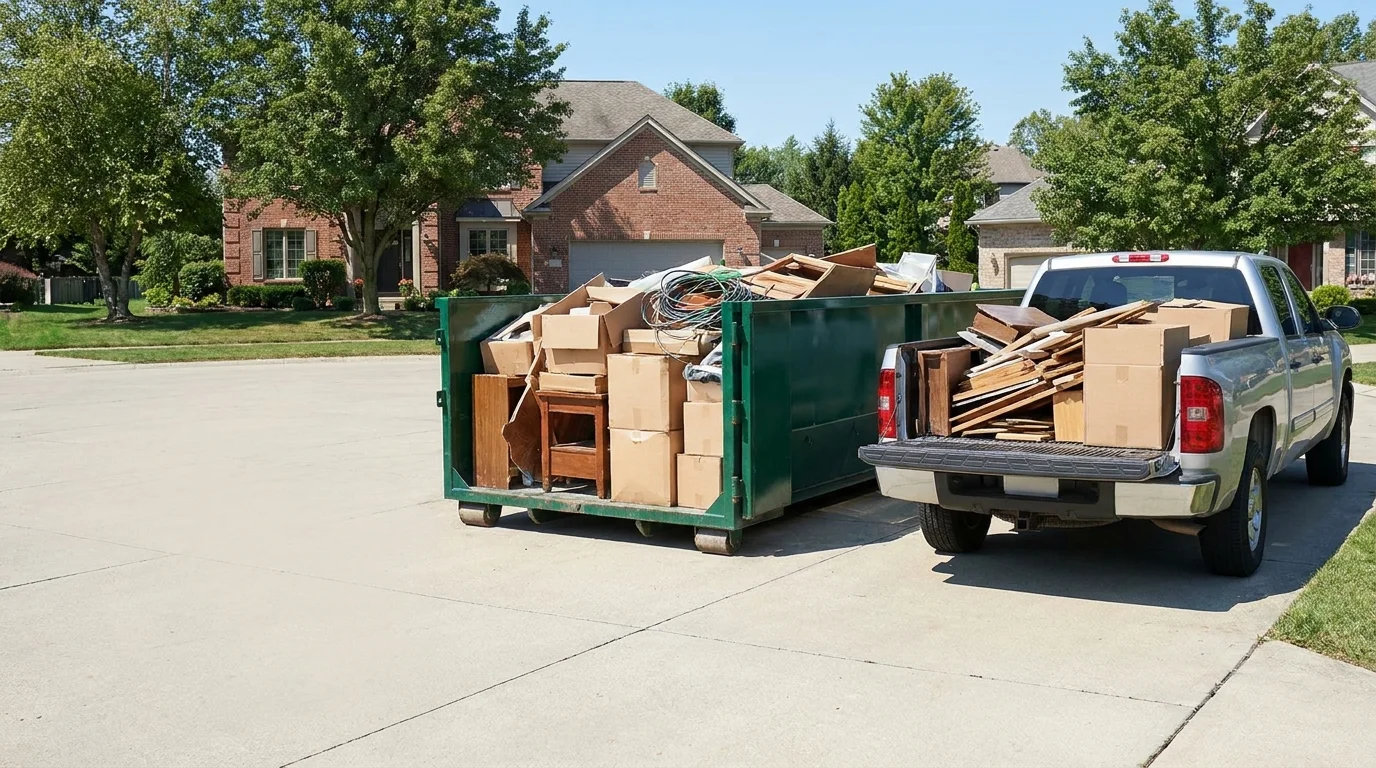
As a general rule, a full-size pickup truck bed holds approximately 2 to 3 cubic yards of material when loaded level with the bed rails. Using that estimate, a 10-yard dumpster may hold around 3 to 5 pickup loads, while a 20-yard dumpster may hold approximately 7 to 10 loads. Larger 30-yard and 40-yard containers can accommodate even more.
However, these numbers are estimates rather than exact measurements. Pickup truck bed dimensions vary, debris does not always stack neatly, and heavy materials can reach a dumpster’s weight allowance before the container is full.
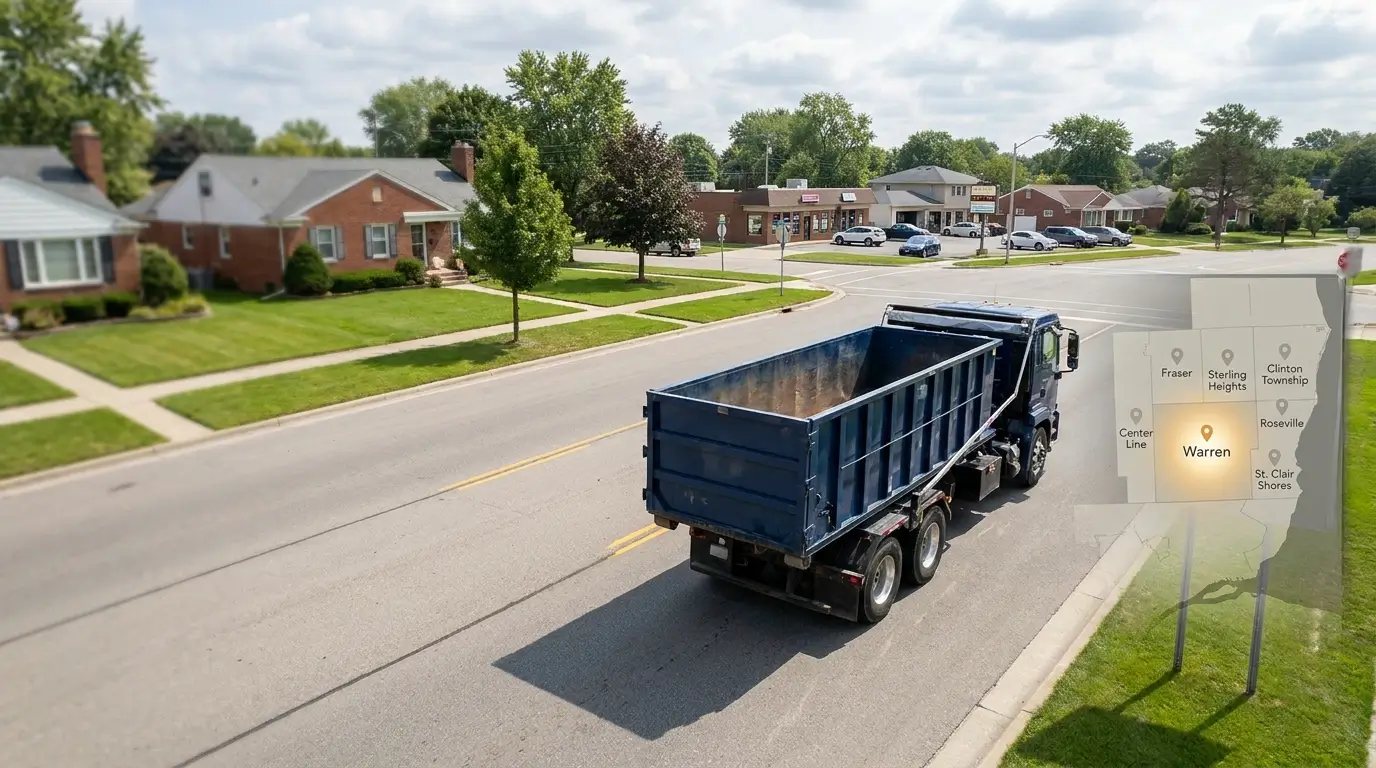
If you are planning a cleanup or renovation in Warren, Michigan, understanding these differences can help you choose a dumpster that fits your project without paying for unnecessary capacity or arranging an additional haul.
This guide explains how pickup-truck loads compare with dumpster sizes, how to estimate your debris volume, and what to consider before selecting a roll-off container.
How Many Pickup Truck Loads Fit in a Dumpster?
A typical full-size pickup truck bed can hold approximately 2 to 3 cubic yards of material when loaded level. The actual capacity depends on the truck’s bed length, width, height, and how efficiently the debris is arranged.
Using that estimate, here is a general comparison of common dumpster sizes.
| Dumpster Size | Approximate Pickup Truck Loads |
|---|---|
| 10-yard dumpster | 3–5 loads |
| 15-yard dumpster | 5–8 loads |
| 20-yard dumpster | 7–10 loads |
| 30-yard dumpster | 10–15 loads |
| 40-yard dumpster | 13–20 loads |
These figures are intended for planning purposes. They assume a reasonably full pickup bed and do not account for every difference in truck dimensions or debris type.
For example, a pickup carrying flattened cardboard can use its available space more efficiently than one carrying broken furniture, tree branches, or irregular construction debris.
The number of loads also depends on whether the material is loose, compacted, stacked, or mixed.
Why Pickup Truck Load Estimates Are Useful
Dumpster companies advertise container capacity in cubic yards. A homeowner planning a garage cleanout may find it easier to estimate the project by asking how many pickup loads of unwanted belongings need to be removed.
For example:
- A small garage cleanup might produce two or three pickup loads.
- A larger basement cleanout might produce six or seven loads.
- A substantial home renovation might generate ten or more loads.
- A whole-house cleanout may require a larger container, depending on furniture and household contents.
These comparisons provide a starting point for selecting a dumpster size.
They are not a substitute for measuring the debris or checking the container’s weight allowance, but they make the planning process easier.
How Much Can a Pickup Truck Hold in Cubic Yards?
A cubic yard is a measurement of volume. It represents a space that is 3 feet long, 3 feet wide, and 3 feet high.
A full-size pickup truck bed with approximate interior dimensions of 8 feet long, 5.5 feet wide, and 1.5 feet high has a volume of:
8 × 5.5 × 1.5 = 66 cubic feet
Since one cubic yard equals 27 cubic feet:
66 ÷ 27 = approximately 2.44 cubic yards.
This is an illustrative calculation, not a measurement of every pickup truck. Short-bed trucks have less capacity, and some trucks have wider or deeper beds.
Pickup Bed Size Makes a Difference
Not every pickup truck can carry the same amount of debris.
Common differences include:
- Short-bed pickups: Usually have less available volume than long-bed models.
- Standard-bed pickups: Offer a middle-ground capacity.
- Long-bed pickups: Can accommodate more material when loaded within safe limits.
- Pickup trucks with bed covers: May have less usable vertical space.
- Trucks with wheel-well obstructions: Have a different usable interior shape.
A pickup bed’s volume also does not tell you how much weight the vehicle can safely carry. The manufacturer’s payload rating still applies.
Level Loads Versus Heaped Loads
A level load stays within the bed’s sides and is generally easier to estimate.
A heaped load extends above the bed rails. Although it may appear to hold more material, it creates additional safety and transportation concerns.
Loose debris can shift or fall during transport. Always follow the vehicle manufacturer’s payload limits and applicable transportation rules. Do not overload a pickup truck to increase the number of cubic yards it carries.
For dumpster planning, use a consistent level-load estimate rather than assuming every pickup trip carries an oversized pile.
Understanding Dumpster Sizes in Pickup Truck Loads
Different dumpster sizes serve different project needs. Comparing them with pickup loads can help you decide which container is appropriate.
10-Yard Dumpster: Approximately 3 to 5 Pickup Loads
A 10-yard dumpster is generally suited to smaller cleanup and renovation projects.
It may be a practical choice for:
- Small garage cleanouts
- Basement decluttering
- Single-room renovations
- Small bathroom remodels
- Yard waste removal, where accepted
- Removing a limited amount of household junk
- Small flooring removal projects
If your project would produce around three to five pickup loads, a 10-yard container may provide sufficient capacity.
However, bulky items can change the estimate. A few large pieces of furniture may occupy more space than several pickup loads of compact, stackable material.
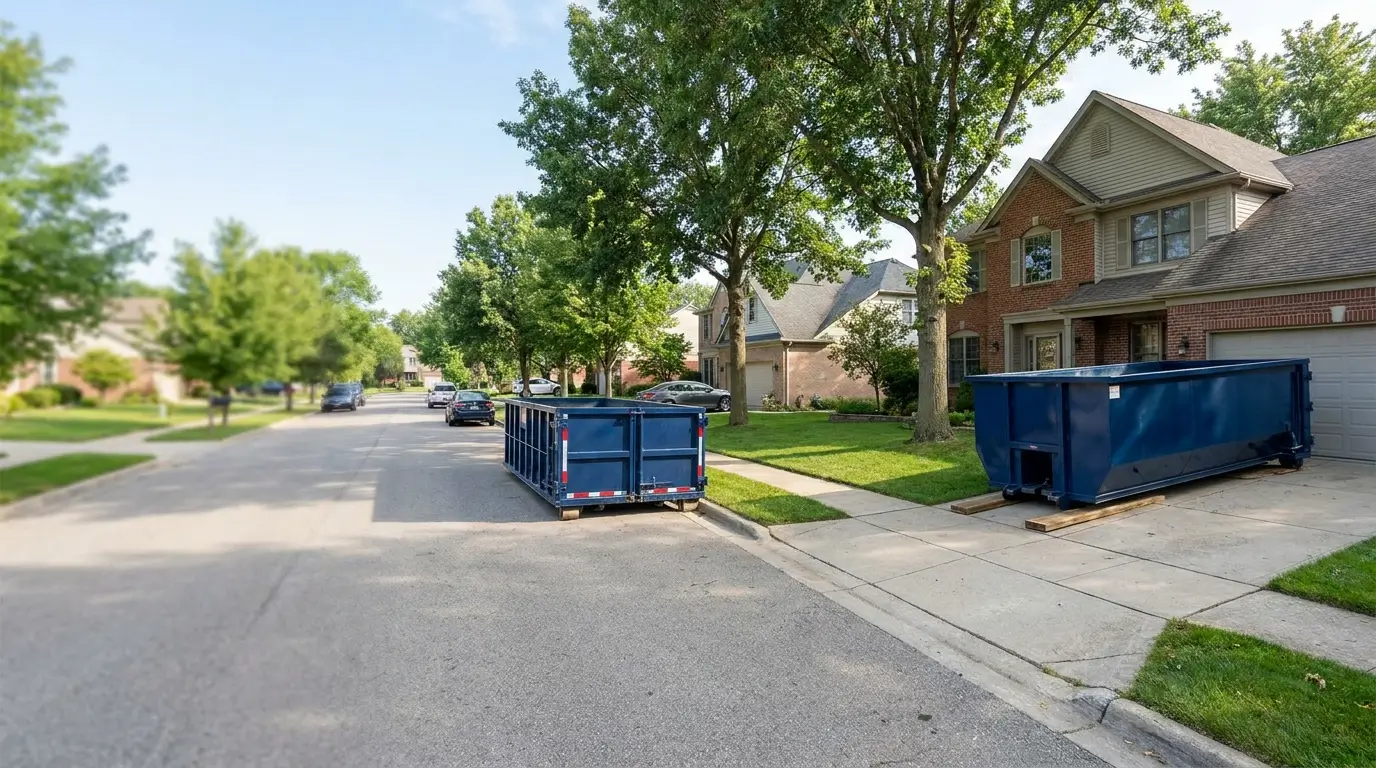
A 10-yard container is also worth considering when driveway space is limited, provided the actual container and delivery truck can access the placement area.
15-Yard Dumpster: Approximately 5 to 8 Pickup Loads
A 15-yard dumpster provides additional capacity for projects that are larger than a small cleanup but may not require a 20-yard container.
Potential uses include:
- Medium-sized garage cleanouts
- Larger basement cleanouts
- Multiple-room decluttering
- Small deck removal projects
- Flooring replacement in several areas
- Moderate household renovation debris
If your estimated waste volume falls between five and eight pickup loads, a 15-yard container may be worth comparing with a 10-yard or 20-yard option.
The right choice depends on the type of debris, the amount of bulky material, and the rental terms offered by the provider.
20-Yard Dumpster: Approximately 7 to 10 Pickup Loads
A 20-yard dumpster is a common option for larger residential projects.
It may work well for:
- Kitchen remodeling
- Single-floor renovations
- Large garage cleanouts
- Basement and attic cleanouts
- Flooring removal
- Small-to-medium roofing projects
- Deck removal
- Moving-related cleanouts
If you estimate that your project will produce seven to ten pickup loads, a 20-yard dumpster is a reasonable starting point.
For example, a homeowner in Warren removing old cabinets, countertops, flooring, and drywall from a kitchen may find this size suitable.
The actual capacity needed depends on how much material is removed and whether other rooms are part of the project.
If the debris includes concrete, tile, brick, or shingles, check the weight allowance before choosing the container.
30-Yard Dumpster: Approximately 10 to 15 Pickup Loads
A 30-yard dumpster provides substantially more room than a 20-yard container. It is often appropriate for large cleanouts and renovation projects.
Common uses include:
- Whole-house cleanouts
- Multi-room renovations
- Large estate cleanouts
- Major flooring and drywall removal
- Large roofing projects
- Construction debris
- Property preparation and renovation
If your estimated debris volume is around ten to fifteen pickup loads, a 30-yard dumpster may be a suitable option.
For example, a property manager clearing an entire rental home may need to dispose of furniture, carpeting, shelving, cabinets, and other unwanted materials.
A larger container can reduce the risk of running out of space during the project. However, it may require more driveway clearance and can have a higher rental price.
40-Yard Dumpster: Approximately 13 to 20 Pickup Loads
A 40-yard dumpster is one of the largest commonly available roll-off container sizes.
It is generally intended for substantial projects that produce a large volume of waste.
Potential applications include:
- Large commercial cleanouts
- Major construction projects
- Large-scale property renovations
- Extensive demolition work
- Large estate cleanouts
- Commercial building cleanouts
- Significant amounts of bulky, accepted debris
If your project is expected to produce approximately 13 to 20 pickup loads, a 40-yard container may be worth considering.
However, not every project that produces this much waste should use a 40-yard dumpster. Heavy materials can exceed weight restrictions long before the container reaches its volume capacity.
For large commercial or construction jobs, ask the provider whether multiple containers, scheduled exchanges, or separate containers for different materials would be more appropriate.
How to Estimate Your Own Debris Volume
Pickup-load estimates are helpful, but measuring your debris pile can provide a more accurate starting point.
You do not need professional equipment. A measuring tape and a basic calculation are usually enough for a reasonably organized pile.
Step 1: Estimate the Length, Width, and Height
Measure the approximate dimensions of the waste pile in feet.
For example, imagine a pile that measures:
- Length: 8 feet
- Width: 6 feet
- Height: 3 feet
Multiply the three measurements:
8 × 6 × 3 = 144 cubic feet.
This gives you the approximate volume of the pile.
Step 2: Convert Cubic Feet Into Cubic Yards
A dumpster’s capacity is measured in cubic yards, so you need to divide the cubic-foot measurement by 27.
Using the example:
144 ÷ 27 = approximately 5.33 cubic yards.
Your estimated pile occupies about 5.33 cubic yards.
Step 3: Add a Buffer for Irregular Shapes
Real-world debris rarely forms a perfect rectangle.
Furniture, broken cabinets, tree branches, and construction materials create empty spaces when loaded. This means the total container space required may be greater than the calculated volume of the pile.
As a planning method, consider adding approximately 10% to 15% for irregular shapes and air gaps.
For the example above:
5.33 cubic yards plus a 10% to 15% buffer equals approximately 5.86 to 6.13 cubic yards.
This is still an estimate. Large bulky objects may require more room, while neatly stacked or broken-down materials may use space more efficiently.
Step 4: Compare Your Estimate With Available Dumpster Sizes
Once you have an approximate volume, compare it with the common container sizes.
For example:
- Around 5 cubic yards: Consider a 10-yard dumpster.
- Around 8 cubic yards: Compare 10-yard and 15-yard options.
- Around 12 cubic yards: Consider a 15-yard or 20-yard dumpster.
- Around 18 cubic yards: A 20-yard dumpster may be appropriate.
- Around 25 cubic yards: Consider a 30-yard dumpster.
- Around 35 cubic yards: A 40-yard dumpster may be worth discussing.
These are starting points, not strict booking rules. Always leave enough room for irregular debris and confirm the provider’s loading requirements.
Why the Type of Debris Changes the Number of Pickup Loads
Two projects can produce the same number of pickup loads but require different dumpster arrangements.
The reason is that debris varies in size, shape, density, and weight.
Household Junk and Furniture
Household cleanouts often include furniture, clothing, boxes, shelving, toys, and miscellaneous belongings.
These materials can be bulky without being especially heavy.
A couch, mattress, or large cabinet may take up substantial container space even though it weighs less than a comparable volume of concrete or masonry.
For household cleanouts, available volume is often a major factor.
Construction and Remodeling Debris
Renovation debris may include:
- Drywall
- Wood framing
- Cabinets
- Flooring
- Carpet and padding
- Doors
- Trim
- Countertops
- Fixtures
Some materials can be broken down to use container space more efficiently. Others remain bulky or awkward.
A kitchen renovation, for example, may generate cabinets, countertops, flooring, drywall, and packaging waste. Estimate each material separately rather than assuming the entire project will produce a predictable number of pickup loads.
Roofing Shingles
Roofing shingles can be much heavier than ordinary household junk.
A pickup load of shingles may reach a vehicle’s payload limit before the bed is filled to its physical capacity. The same issue applies to dumpsters: the weight allowance may be reached while substantial container space remains.
Before arranging a dumpster for a roofing project, ask the provider about:
- Included weight allowance
- Shingle disposal restrictions
- Whether multiple shingle layers are accepted
- Additional weight charges
- Recommended container size for the roof area
Concrete, Brick, and Dirt
Concrete, brick, dirt, and similar materials require particular care.
They are dense and can become extremely heavy in relatively small quantities.
Do not assume that a 20-yard or 30-yard dumpster can be filled with concrete simply because the container has enough physical space.
Some providers offer dedicated containers for heavy debris or impose special loading limits. Confirm these requirements before arranging delivery.
Why Weight Limits Matter More Than Pickup Loads
Pickup-truck comparisons help estimate volume, but they do not tell you whether the material is within the dumpster’s permitted weight allowance.
Every rental provider establishes weight terms for its containers. These terms can vary by container size, disposal facility, material type, and rental arrangement.
A Large Dumpster Can Be Overweight Before It Is Full
Consider a project involving concrete removal.
The debris may occupy only a small part of a 20-yard dumpster, but its weight can already be close to the provider’s permitted limit.
By comparison, a 20-yard container filled with lightweight cardboard and household junk may reach its volume limit without approaching the same weight.
This is why pickup-load estimates should always be combined with a material assessment.
Ask About Weight Allowances Before Booking
Before choosing a container, ask:
- What weight allowance is included in the rental?
- What happens if the load exceeds that allowance?
- How are additional weight charges calculated?
- Are heavy materials accepted?
- Are there special restrictions for roofing, concrete, dirt, or brick?
- Should heavy debris be placed in a separate container?
These questions can help prevent unexpected charges and unsuitable container selections.
For a deeper explanation, read our guide: Dumpster Overage Fees: How Weight Limits Affect Your Final Bill.
Common Mistakes When Estimating Pickup Truck Loads
A simple load count can be useful, but several mistakes can make your estimate inaccurate.
1. Assuming Every Pickup Truck Has the Same Capacity
A short-bed pickup cannot carry the same volume as a long-bed pickup when both are loaded to the same height.
If you are counting trips from a smaller truck, do not automatically use the same estimate as a full-size long-bed pickup.
2. Counting Only the Visible Debris
A garage or attic may contain more waste than you initially notice.
Boxes behind stored furniture, old shelving, unused appliances, and items stacked in corners can add significant volume.
Walk through the entire area before estimating the number of loads.
3. Forgetting About Demolition Waste
A renovation project may look small before demolition begins.
Once cabinets, flooring, drywall, countertops, and fixtures are removed, the amount of debris can increase quickly.
Estimate the waste that will be created during the project, not just the material already sitting outside.
4. Ignoring Empty Spaces Between Objects
A pile of broken furniture may appear to occupy five cubic yards, but irregular shapes can create substantial gaps when loaded.
Breaking down large items when practical can help use the available space more efficiently.
5. Ignoring Weight Restrictions
Counting pickup loads is not enough when dealing with shingles, concrete, dirt, brick, or tile.
Heavy debris can reach the permitted weight allowance before the container looks full.
6. Forgetting About Prohibited Materials
Not every item can be placed in a standard roll-off dumpster.
Paint, batteries, chemicals, tires, refrigerant-containing appliances, and other restricted materials may require separate disposal arrangements.
Ask the provider for its accepted-material list before loading anything questionable.
How to Load a Dumpster Efficiently
Good loading practices can help you use the available space without exceeding the container’s requirements.
Break Down Large Items
Disassemble furniture, remove detachable shelves, and break down large cardboard boxes when practical.
Smaller pieces are easier to arrange than bulky objects with large empty spaces.
Place Flat Materials Carefully
Flat materials such as doors, plywood, and certain panels can often be arranged along the container’s sides or in organized layers.
Follow the provider’s instructions and avoid placing materials in a way that creates an unstable load.
Distribute Debris Evenly
Avoid concentrating all the heavy material in one section.
Even distribution helps prevent an uneven load. Follow any instructions provided by the rental company about loading heavy items.
Keep the Container Below the Fill Line
Do not load material above the container’s designated fill line or top edge.
Overfilled dumpsters may not be safe or eligible for pickup. The provider may require material to be removed before transportation.
Separate Materials When Required
Some projects involve materials that should not be mixed with general household or construction waste.
Ask whether concrete, dirt, roofing shingles, yard debris, or other materials need a separate container.
Which Dumpster Size Should You Choose for Your Project in Warren, MI?
The right dumpster size depends on the type of work you are doing and how much debris you expect to generate.
Here are some general examples for projects around Warren, Michigan.
Garage Cleanout
A small garage cleanout may produce only a few pickup loads of unwanted items. A 10-yard dumpster may be sufficient.
A garage filled with old furniture, shelving, appliances, and years of stored belongings may require a 15-yard or 20-yard option.
Basement Cleanout
Basement cleanouts often include boxes, old furniture, shelving, carpeting, and household junk.
A 10-yard or 15-yard dumpster may work for a smaller project. A larger basement with bulky furniture and renovation debris may require a 20-yard container.
Kitchen Remodeling
A kitchen renovation can produce cabinets, countertops, flooring, drywall, and fixtures.
A 20-yard dumpster may be a reasonable starting point for a substantial kitchen renovation, depending on the extent of demolition and the materials involved.
Whole-House Cleanout
A complete property cleanout may involve several rooms, furniture, appliances, stored belongings, and miscellaneous waste.
A 30-yard dumpster may provide more practical capacity than a smaller container, although the final choice depends on the property’s contents.
Roofing Project
Roofing projects should be estimated by roof size, material, number of layers, and weight allowance rather than pickup loads alone.
Ask the provider for guidance on the appropriate container and its permitted shingle weight.
Construction or Demolition
Large construction and demolition projects may generate enough debris to require a 30-yard or 40-yard dumpster.
For ongoing work, ask about scheduled exchanges or additional containers so waste removal does not interrupt the project.
How to Avoid Paying for More Dumpster Capacity Than You Need
Choosing the largest available container is not always the most economical decision.
A smaller dumpster may cost less when your project has a limited amount of debris. However, choosing a container that is too small can lead to extra pickup or exchange costs.
Use these steps to make a more informed decision.
- List the materials: Identify furniture, construction debris, flooring, drywall, roofing, and other waste.
- Estimate the pickup loads: Use your truck’s bed capacity as a starting point.
- Measure bulky piles: Calculate length × width × height where possible.
- Add a volume buffer: Account for irregular shapes and empty spaces.
- Check weight restrictions: Pay particular attention to dense materials.
- Compare rental terms: Review included weight, rental days, delivery, pickup, and additional fees.
- Confirm placement: Make sure the container and delivery truck can access your property.
For more practical ways to manage rental costs, see our related article: 7 Ways to Lower Your Dumpster Rental Bill.
Frequently Asked Questions
How many pickup truck loads fit in a 10-yard dumpster?
A 10-yard dumpster generally holds approximately three to five full-size pickup truck loads when each truck is loaded level with the bed rails. The actual number depends on the pickup bed dimensions and type of debris.
How many pickup truck loads fit in a 15-yard dumpster?
A 15-yard dumpster may hold approximately five to eight pickup truck loads. This is a planning estimate based on a full-size pickup carrying around two to three cubic yards per load.
How many pickup truck loads fit in a 20-yard dumpster?
A 20-yard dumpster typically holds approximately seven to ten pickup truck loads. Bulky furniture and irregular construction debris may reduce the number of loads that fit.
How many pickup truck loads fit in a 30-yard dumpster?
A 30-yard dumpster can generally accommodate around ten to fifteen pickup truck loads. Its additional capacity makes it useful for whole-house cleanouts, multi-room renovations, and larger construction projects.
How many pickup truck loads fit in a 40-yard dumpster?
A 40-yard dumpster may hold approximately thirteen to twenty pickup truck loads, depending on the pickup bed dimensions and loading method.
How many cubic yards does a full-size pickup truck hold?
A full-size pickup truck bed may hold approximately two to three cubic yards when loaded level. Actual capacity depends on the bed’s length, width, and usable height.
Is a pickup truck load the same as one cubic yard?
No. One cubic yard equals 27 cubic feet. A full-size pickup truck bed commonly holds more than one cubic yard, often around two to three cubic yards when filled level.
How do I calculate cubic yards from feet?
Multiply the length, width, and height in feet to calculate cubic feet. Then divide the result by 27 to convert it into cubic yards.
For example, a pile measuring 6 feet long, 4 feet wide, and 3 feet high contains:
6 × 4 × 3 = 72 cubic feet.
72 ÷ 27 = approximately 2.67 cubic yards.
What if I only have half a pickup truck load?
A half pickup load may represent approximately one to one-and-a-half cubic yards if a full-size pickup normally holds two to three cubic yards. A 10-yard dumpster would generally provide considerably more capacity than that, although minimum rental requirements and pricing still apply.
Does the way I load a dumpster affect how many pickup loads fit?
Yes. Breaking down boxes, disassembling furniture, and arranging flat materials can help reduce wasted space. Irregular objects and loose branches create gaps that reduce usable capacity.
Can a dumpster become overweight before it is full?
Yes. Dense materials such as concrete, brick, dirt, tile, and roofing shingles can reach the weight allowance before the container reaches its volume capacity.
Should I choose a 20-yard or 30-yard dumpster for a large cleanout?
A 20-yard dumpster may be sufficient for a large garage, basement, or limited-area cleanout. A 30-yard dumpster is often more suitable for whole-house cleanouts or projects involving multiple rooms. Estimate the waste volume and confirm weight restrictions before booking.
Are pickup-load estimates accurate enough to choose a dumpster?
They are useful for initial planning, but they are not exact. Pickup bed sizes, debris shapes, loading methods, and material weights all affect the result. For a large project, provide the provider with a description of the materials and estimated volume before choosing a container.
Final Thoughts
Pickup-truck loads make dumpster capacity easier to understand because they turn cubic yards into a familiar measurement.
As a general guide, a 10-yard dumpster holds around three to five pickup loads, a 20-yard holds seven to ten, a 30-yard holds ten to fifteen, and a 40-yard holds approximately thirteen to twenty.
Use these estimates as a starting point, then consider the actual dimensions of your debris pile, the type of material being discarded, and the container’s weight allowance.
For a project in Warren, Michigan, planning these details before delivery can help you choose an appropriate dumpster size and avoid unnecessary rental expenses.
Warren Dumpster Rental helps connect customers with independent dumpster rental providers serving Warren and nearby communities where coverage is available. The provider you are matched with handles availability, rental arrangements, pricing, and billing. Container sizes, weight allowances, accepted materials, and delivery requirements vary by provider.